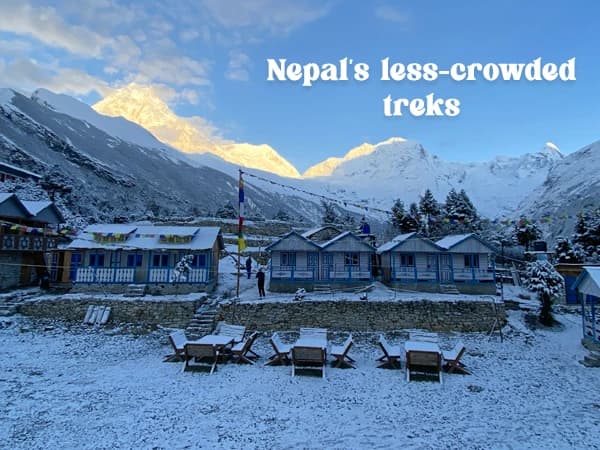
Namche Bazaar sits at 3,440m in the Solukhumbu District, built into a natural amphitheatre above the confluence of the Bhote Koshi and Dudh Koshi rivers. It is the commercial capital of the Khumbu region and the mandatory acclimatization stop on every major Everest region trek.
Every trekker heading to Everest Base Camp, Gokyo Lakes, or the Three Passes spends at least two nights here. This guide covers what our guides observe on the ground: altitude effects, our acclimatization protocol, current permit costs, facilities, food, and the questions trekkers ask most before arriving.
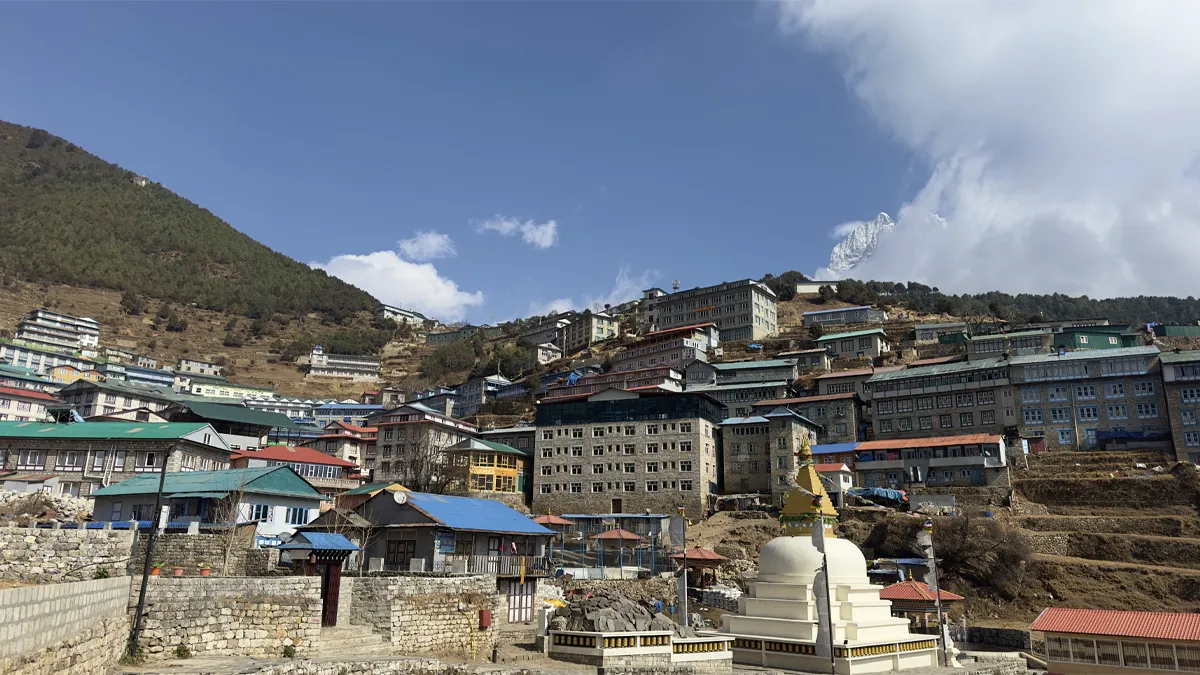
Namche Bazaar at 3,440m. The town has over 50 lodges, 30 gear shops, two ATMs, and a Saturday market that draws traders from across the Khumbu valley.
Altitude and location
Namche Bazaar is at 3,440m (11,286ft). The Sagarmatha National Park check post sits just below the town at the Monjo gate, where rangers verify permits before allowing entry. From Lukla at 2,860m, standard itineraries reach Namche in two trekking days: overnight in Phakding, then a 6 to 7 hour climb the following day.
The final 3km into Namche climbs roughly 600m. This section is consistently the hardest single ascent in the first half of the EBC route. Trekkers who underestimate it and push too fast are often the ones struggling most on acclimatization day. Start early, before afternoon cloud builds over the Hillary Suspension Bridge section at 3,300m.
From Namche, distances and approximate walking times to the next major stops:
Tengboche — 10km, 5 to 6 hours
Dingboche — 19km, 2 days
Lobuche — 28km, 3 days
Gorak Shep — 35km, 4 days
Everest Base Camp — 38km, 4 days
Acclimatization in Namche Bazaar
Standard EBC itineraries spend 2 nights in Namche. This is not optional padding. It is the most important safety decision in the first half of the trek.
The climb from Phakding to Namche gains over 800m in a single day. The body needs 24 to 36 hours to begin producing additional red blood cells in response to the drop in oxygen pressure. Skipping or shortening the Namche stop is the most common reason our guides see trekkers develop serious altitude sickness above Dingboche.
The acclimatization day hike climbs to 3,880m and returns to sleep at 3,440m. This single day significantly improves your odds above Dingboche.
The acclimatization day hike to Everest View Hotel
On the rest day, our guides take groups up to the Everest View Hotel at 3,880m. The return hike takes 2.5 to 3 hours from town and gains approximately 440m. You ascend, expose your body to higher altitude, then return to sleep at 3,440m. This is the standard "climb high, sleep low" method used across all Himalayan trekking.
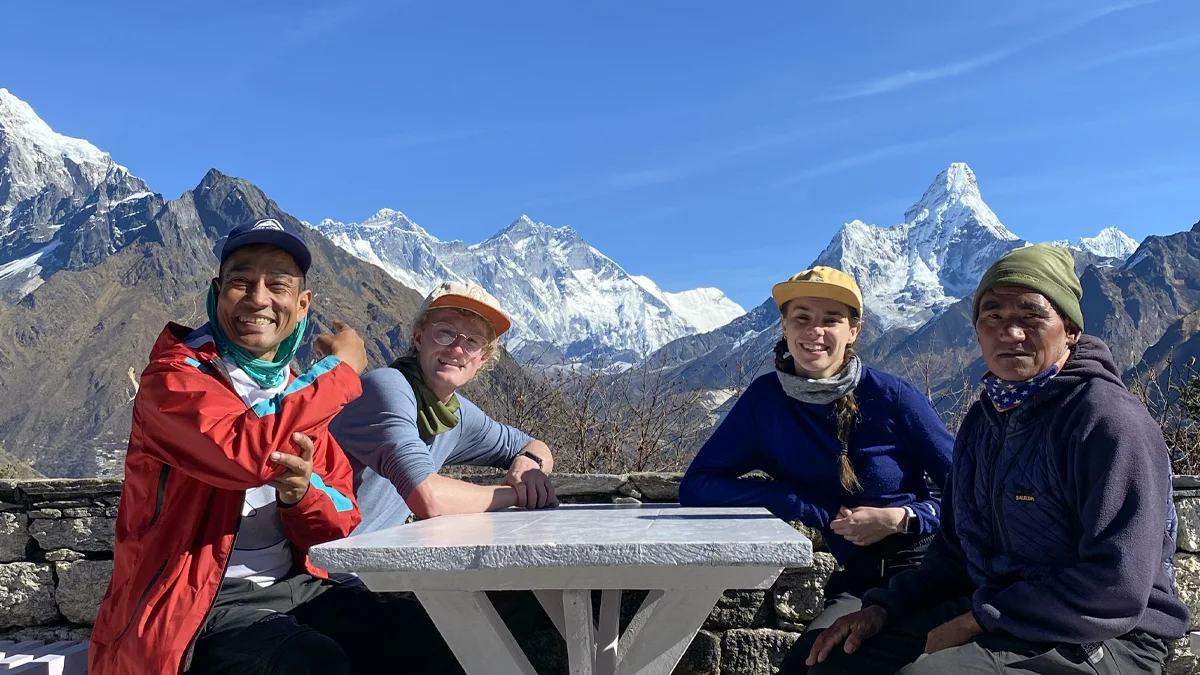
From the ridge you get direct sight lines to Everest (8,849m), Lhotse (8,516m), Ama Dablam (6,812m), and Thamserku (6,623m) on a clear morning. Most trekkers find this hike genuinely hard on tired legs. That is precisely the point. The body is being pushed at altitude, then given time to recover at a lower sleeping elevation.
Altitude symptoms: what is normal and what is not
Expect headache, reduced appetite, and disrupted sleep during the first night in Namche. These are common and typically resolve by the second night.
Normal at Namche (first night):
Mild headache, especially overnight
Reduced appetite
Disrupted or light sleep
Slight breathlessness on stairs
Fatigue from the climb up from Phakding
Descend immediately and tell your guide if you notice:
Confusion or difficulty thinking clearly
Loss of coordination or balance
Dry, persistent cough at rest
Chest tightness at rest
Headache that worsens through the night despite rest
Confusion, loss of coordination, a dry persistent cough, and chest tightness at rest are signs of High Altitude Cerebral Edema (HACE) or High Altitude Pulmonary Edema (HAPE). Both are medical emergencies. Descent is the only reliable treatment. Do not take Diamox to mask symptoms without informing your guide, as it can reduce the subjective sense of sickness while the underlying condition worsens.
Permits required before entering Namche Bazaar
Two permits are checked at the Sagarmatha National Park gate near Monjo, approximately 90 minutes below Namche on foot. Both must be carried as originals at all times. Rangers check at Monjo, again at Namche, and at checkpoints above. Photocopies are not accepted.
Sagarmatha National Park Entry Permit
Cost: NPR 3,000 (approximately USD 20)
Where to get it: Nepal Tourism Board office, Pradarshani Marg, Kathmandu (Sunday to Thursday 10am to 5pm, Friday until 3pm), or at the Sagarmatha National Park entry gate in Monjo
Documents required: Valid passport, cash in Nepali rupees only
Note: Free for children under 10 years. No USD or foreign currency accepted at any counter.
Khumbu Pasang Lhamu Rural Municipality Permit
Cost: NPR 3,000 (approximately USD 20)
Where to get it: Rural Municipality counter at Lukla airport on arrival day, or the Sagarmatha National Park counter at Monjo
Documents required: Valid passport, cash in Nepali rupees only
Note: This permit replaced TIMS in the Khumbu region. TIMS is no longer required or enforced in the Everest and Khumbu region as of 2026.
Important: Withdraw enough Nepali rupees before flying to Lukla. Permit fees are payable in cash only. No USD or foreign currency is accepted at any permit counter. The ATMs in Thamel, Kathmandu are your last reliable cash point before the trek begins. Trekking with Shikhar Adventure, your guide handles both permits at Lukla. You just enjoy the trail.
What to do in Namche Bazaar
Everest View Hotel hike at 3,880m
The standard acclimatization day hike and the most productive use of your rest day. The round trip covers approximately 4km and takes 2.5 to 3 hours from town. On a clear morning, you get an unobstructed view of Everest, Lhotse, Ama Dablam, and Thamserku. This is also the primary acclimatization exercise that prepares your body for Tengboche and beyond.
Khumjung and Khunde village loop
A 4 to 5 hour extension of the Everest View Hotel hike, walking through Khumjung village. The Hillary School, established by Sir Edmund Hillary and still operating through the Himalayan Trust, is here. The Khumjung Monastery holds what is claimed to be a Yeti scalp. Khunde hosts the Edmund Hillary Hospital. This loop adds meaningful altitude exposure without serious additional exertion.
Sherpa Culture Museum
Located in the grounds of the Sagarmatha National Park Visitor Centre above town. Free entry. Covers the history, tools, traditional clothing, and mountaineering records of the Sherpa community. Worth 45 to 60 minutes on acclimatization morning before the day hike.
Saturday market
The Namche Saturday market runs weekly, drawing traders from villages across the Khumbu valley. It starts at dawn and winds down by midday. If your itinerary arrives on a Friday evening, walk through it before departure on Saturday morning. It is one of the few genuine Sherpa trading markets still active on the EBC route.
Mountain views from the ridge above town
The ridge directly above Namche provides a clear sightline to Everest, Lhotse, and Ama Dablam on a clear morning without hiking to 3,880m. Views are best before 8am, before cloud builds from the valley below. A short 20 minute walk from the main square reaches the viewing area.
Namche Bazaar sitting in a natural amphitheatre at 3,440m.
Accommodation in Namche Bazaar
Namche has more than 50 teahouses and lodges, offering the widest accommodation range of any stop on the EBC route. Unlike the villages above 4,000m, Namche has options across all budgets and genuine attached bathroom facilities. Current 2026 price ranges:
Basic — NPR 500 to 800 per night. Double room, shared bathroom, no attached facilities.
Mid-range — NPR 2,000 to 3,500 per night. Attached bathroom, heated room, hot shower available. This is what Shikhar Adventure uses for our groups.
Luxury teahouses — USD 50 to 200 per night. Ensuite bathrooms, heated rooms, mountain view windows in some properties. Luxury-standard rooms do not exist above Namche in the same form.
Hot showers are available at most lodges: NPR 200 to 400 as an additional charge. Above Namche, shower availability decreases and prices rise. Fatigue accumulates fast above 4,000m and a decent sleep environment matters more than most trekkers expect before they arrive.
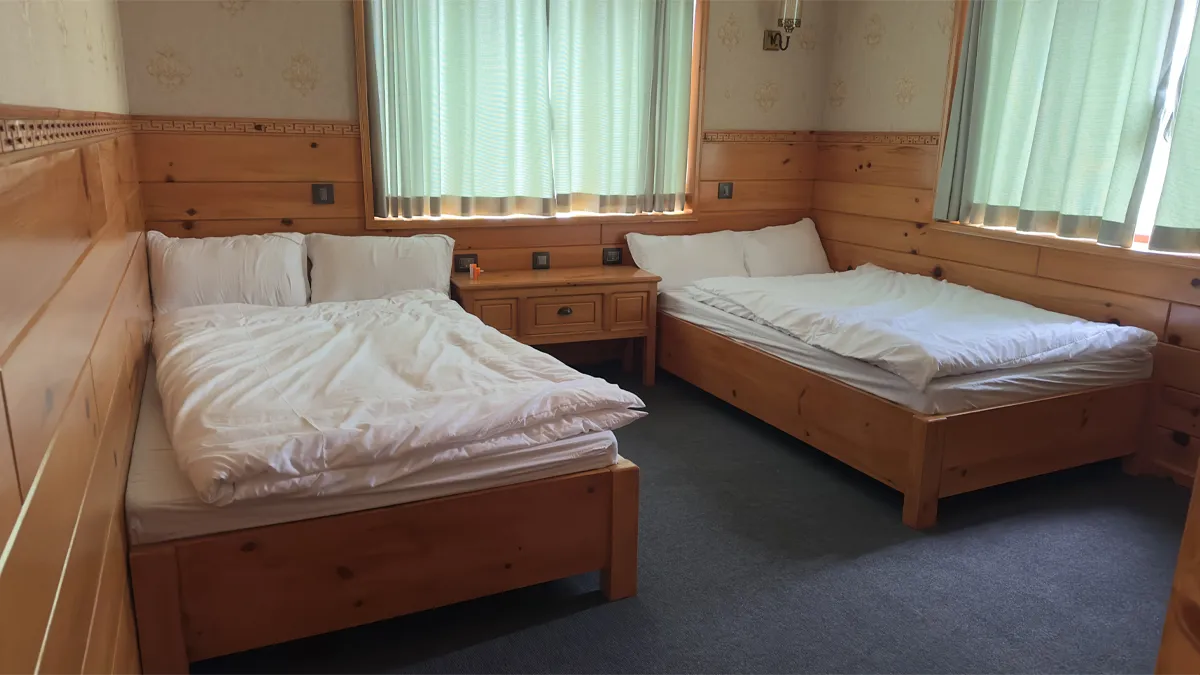
A standard teahouse room in Namche Bazaar, Khumbu, Nepal
ATMs, money and connectivity
Service
Availability
Cost and notes
ATMs
2 machines in Namche (Nepal Investment Bank, Himalayan Bank)
Frequently empty in April and October. Last reliable cash point on the EBC route. No ATMs above Namche.
Wi-Fi
Most lodges
NPR 200 to 500 per day. Handles email and messaging. Video calls inconsistent.
Mobile data
NTC and Ncell networks in Namche
Speed drops above 4,000m. Carry a local SIM from Kathmandu.
Device charging
Most lodges
NPR 100 to 200 per device. Carry a portable battery for above Namche.
Gear shops
Approximately 30 shops
Jackets, sleeping bags, poles, boots for sale and rent. Prices 20 to 30 percent above Thamel, Kathmandu.
Important: Withdraw enough Nepali rupees in Kathmandu to cover the full route to Gorak Shep and back. Budget at least NPR 60,000 to 80,000 per person beyond the package cost for a 14-day EBC trek. The Namche ATMs can and do run out of cash during peak season.
Food and eating at this altitude
Namche has the widest food selection of any stop on the EBC route. Trekkers can find dal bhat, momos, pasta, wood-fired pizza, freshly baked bread, espresso, and soup. Bakeries open early and are useful for buying high-calorie snacks to carry above Namche, where food variety drops significantly after Tengboche.
Dal bhat is the best choice at altitude. It is high in carbohydrates, freshly cooked, refillable at most lodges at a fixed price (NPR 700 to 900), and the safest option from a digestive standpoint. Digestive issues above 4,000m compound fatigue faster than almost anything else on the trek. Avoid raw vegetables and unpeeled fruit above Namche.
Drink 3 to 4 litres of water per day from Namche upward. Alcohol slows the acclimatization process and is best avoided during the first two nights. Above Namche, single-use plastic water bottles are restricted under Sagarmatha National Park regulations. Carry a reusable bottle and purification tablets or a UV pen from Kathmandu.
Treks that pass through Namche Bazaar
Namche Bazaar sits on the main Khumbu trail and is a mandatory stop on every major Everest region route. Every trekker moving toward Base Camp or returning passes through Namche at least twice.
Namche Bazaar is at 3,440m (11,286ft) above sea level, in the Solukhumbu District of the Khumbu region, Nepal. It sits in a natural amphitheatre above the confluence of the Bhote Koshi and Dudh Koshi rivers and is the highest permanently settled trading town in the Khumbu valley.
How many nights should I spend in Namche Bazaar on the EBC trek?
Two nights is the standard for the Everest Base Camp trek and all major Everest region itineraries. The first night allows initial adjustment to the altitude gain from Phakding. The acclimatization day hike on day two applies the climb-high-sleep-low method, exposing the body to 3,880m before returning to sleep at 3,440m. Spending only one night significantly increases the risk of altitude sickness above Dingboche and Lobuche.
Are there ATMs in Namche Bazaar?
Yes. Two ATMs operate in Namche Bazaar, run by Nepal Investment Bank and Himalayan Bank. They work most of the time but regularly run out of cash during April and October, the peak trekking seasons. There are no reliable ATMs above Namche on the EBC route. Withdraw enough Nepali rupees in Kathmandu to cover the full route to Gorak Shep and back.
What permits do I need to enter Namche Bazaar?
Two permits are required and checked at the Sagarmatha National Park gate near Monjo before you reach Namche. The Sagarmatha National Park Entry Permit costs NPR 3,000 plus 13% VAT (total NPR 3,390, approximately USD 26). The Khumbu Pasang Lhamu Rural Municipality Permit also costs NPR 3,000 plus 13% VAT (total NPR 3,390, approximately USD 26). TIMS is no longer required or actively enforced in the Khumbu and Everest region as of 2026. Both permits must be carried as originals. Photocopies are not accepted at any checkpoint.
How hard is the climb from Phakding to Namche Bazaar?
The Phakding to Namche climb is the hardest single ascent in the first half of the EBC route. The trail gains approximately 830m in total, with the final 3km climbing roughly 600m to reach town. Most trekkers take 6 to 7 hours from Phakding including rest stops. Starting before 7am is strongly recommended to avoid afternoon cloud cover and heat on the Hillary Suspension Bridge section at 3,300m.
Can I buy or rent trekking gear in Namche Bazaar?
Yes. Around 30 gear shops in Namche Bazaar sell and rent trekking jackets, sleeping bags, trekking poles, and boots. Prices run 20 to 30 percent above Kathmandu's Thamel market. It is better to buy and rent all essentials before leaving Kathmandu and use Namche shops only for replacements or items you have forgotten.
What is the Namche Bazaar Saturday market?
The Namche Saturday market is a weekly market drawing traders from villages across the Khumbu valley. It runs from early morning to midday every Saturday. Local farmers, craftspeople, and goods traders set up stalls on the main square. Trekkers who time their arrival for Friday evening can walk through the market before continuing the route toward Tengboche.
Is Wi-Fi available in Namche Bazaar?
Wi-Fi is available at most lodges in Namche Bazaar, typically at NPR 200 to 500 per day. It is reliable enough for email, messaging, and light browsing. Video calls are inconsistent and often fail. Mobile data on NTC and Ncell networks also works in Namche, but connectivity degrades significantly above 4,000m.
What food is available in Namche Bazaar?
Namche has the widest food selection on the EBC route, including dal bhat, momos, pasta, wood-fired pizza, freshly baked bread, soup, and espresso. Dal bhat at NPR 700 to 900 is the recommended option at altitude: high in carbohydrates, freshly cooked, and refillable at a fixed price. Bakeries open early and sell snacks useful for carrying to higher altitude stops where food variety is significantly reduced.
Planning your trek through Namche Bazaar
Namche Bazaar is not a stop you pass through quickly. It is the point on the Everest route where your body either builds the foundation for everything above or skips it and pays the price at 4,500m. Two nights, one proper acclimatization hike, both permits carried as originals, and enough Nepali rupees withdrawn before you fly to Lukla. These are the four things that separate trekkers who reach Everest Base Camp from those who turn back between Namche and Dingboche.
Dambar Thapa has guided more than 200 trips through Namche since 2007. He leads some of our Everest region departures personally. Every Shikhar Adventure group spends two full nights here, follows the Everest View Hotel acclimatization hike, and carries both permits processed before leaving Kathmandu. If you have questions about the acclimatization schedule, what to carry above Namche, or how to choose the right itinerary for your fitness level, reach out directly before you book.