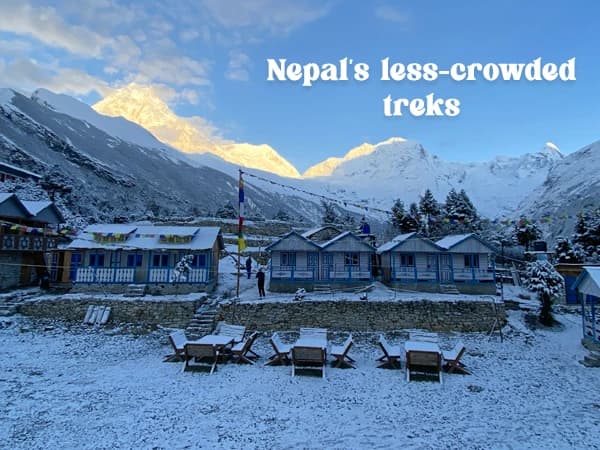
Nepal packs eight of the world's fourteen highest peaks into a country roughly the size of Bangladesh. That density is what makes it different from every other trekking destination on Earth. You can walk for two weeks and never leave sight of an 8,000-meter summit, sleep in a stone teahouse run by the same family for three generations, and share the trail with a yak train one hour and a monk spinning prayer wheels the next.
Trekking here comes in two broad styles. Most routes, including all five in this guide, are teahouse treks: you walk from village to village and sleep in family-run lodges with a bed, a blanket, and a menu of dal bhat, noodles, and momos. A smaller number of remote routes still require camping, with a full crew carrying tents and kitchen gear. Teahouse trekking is more comfortable and, for most first-time visitors, the better starting point.
Altitude is the other thing to plan around. Several of the treks below climb well above 4,000 m (13,123 ft), high enough that Acute Mountain Sickness becomes a real factor regardless of how fit you are. None of that should put you off. It just means picking a route and an itinerary that gives your body time to adjust, which is exactly what this guide is built to help you do.
This guide is for anyone trying to work out which Nepal trek actually fits their time, fitness, and travel style, whether that's a four-day introduction near Pokhara or a three-week expedition into a restricted region most trekkers never reach.
Quick comparison: Nepal's best treks at a glance
Trek
Days
Difficulty
Highest elevation
Best season
Best for
Everest Base Camp (via Gokyo)
15-17
Strenuous
5,555 m / 18,225 ft (Kala Patthar)
Mar-May, Sept-Nov
Serious first-timers, iconic Everest views
Annapurna Base Camp
7-10
Moderate
4,130 m / 13,549 ft
Mar-May, Sept-Nov
Diversity of scenery and culture in one trip
Mardi Himal
5-6
Moderate
4,500 m / 14,764 ft
Mar-May, Sept-Dec
Short trip, big views, fewer crowds
Manaslu Circuit
14-18
Strenuous
5,106 m / 16,752 ft (Larke Pass)
Mar-May, Sept-Nov
Experienced trekkers who want Annapurna without the crowds
Ghorepani-Poon Hill
4-5
Easy
3,210 m / 10,531 ft
Year-round, best Oct-Apr
Beginners, families, short holidays
Langtang Valley (bonus)
7-9
Moderate
3,870 m / 12,697 ft
Mar-May, Sept-Nov
A second trek closer to Kathmandu
1. Everest Base Camp Trek (recommended via the Gokyo route)
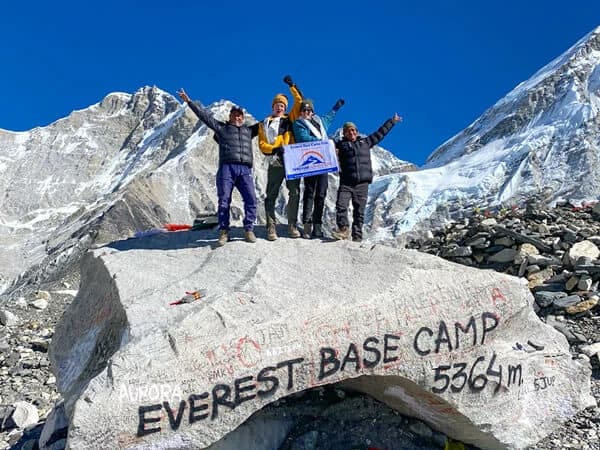
Ask ten guides which trek to do once in your life, and most will say Everest Base Camp. The standard route runs 12-14 days out of Lukla. But if you have two or three extra days, we recommend the Gokyo extension every time, and here's why.
The classic EBC route and the Gokyo route share the same first week: the flight into Lukla at 2,860 m (9,383 ft), the climb through Phakding and Monjo into Sagarmatha National Park, and the acclimatization stop at Namche Bazaar, the Sherpa capital of the Khumbu at 3,440 m (11,286 ft). After climbing above Namche, the trail opens to your first uninterrupted panorama of Everest, Lhotse, Ama Dablam, and Thamserku, one of the moments many trekkers remember long after returning home.
Where the routes split is after Base Camp. Instead of retracing your steps, the Gokyo route crosses the Cho La Pass at 5,420 m (17,782 ft) into the Gokyo Valley, home to six glacial lakes at altitudes few lakes on Earth reach. From there, Gokyo Ri (5,357 m / 17,575 ft) gives you a wide-angle view of four 8,000-meter peaks, Everest, Lhotse, Makalu, and Cho Oyu, from a single viewpoint. It's a harder trek than the standard out-and-back, but if your schedule allows for it, it turns a very good trek into an exceptional one.
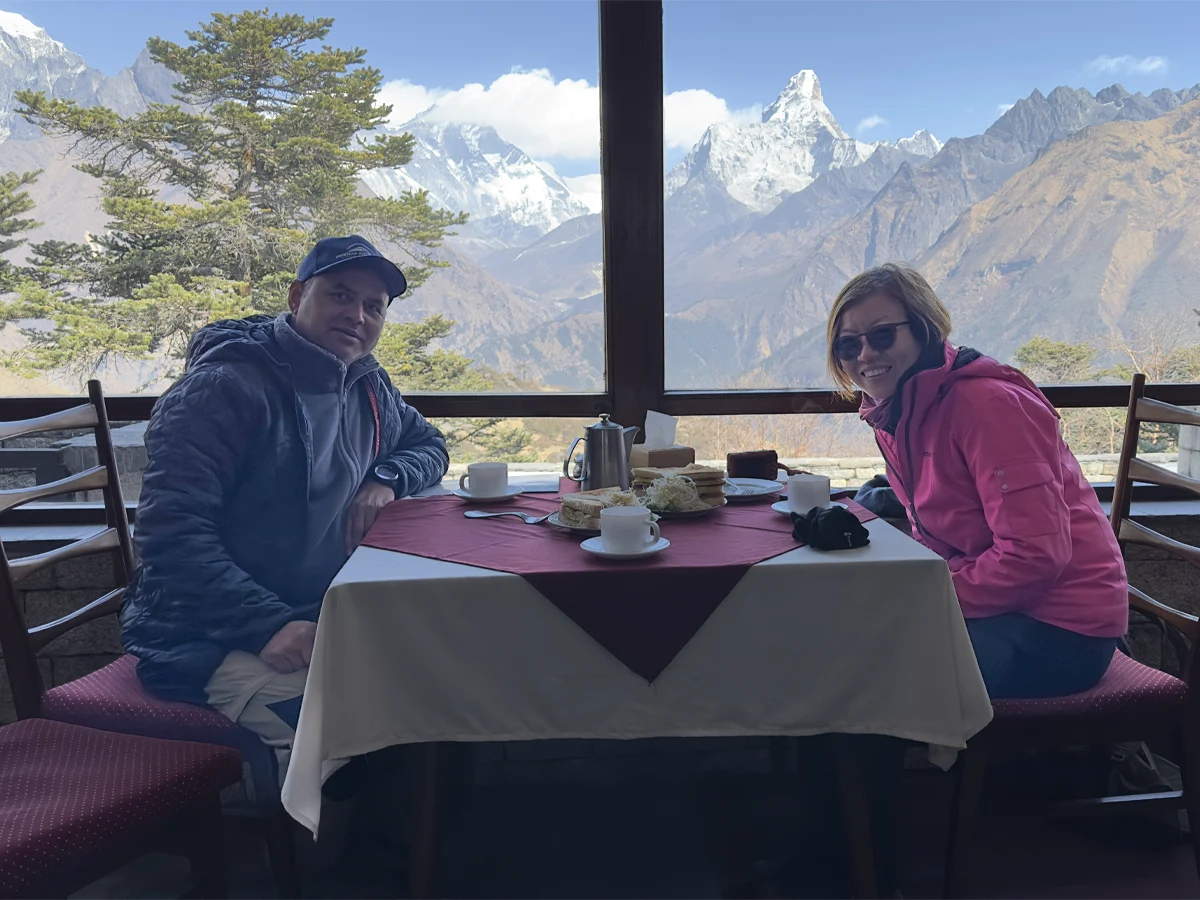
A stop at the Everest View Hotel near Syangboche, one of the highest-placed hotels in the world, is worth adding to either version of the route for the panorama alone.
Trekkers taking in the view from Hotel Everest View, near Namche Bazaar.
What to expect
Permits: Sagarmatha National Park entry permit plus the Khumbu Pasang Lhamu rural municipality fee.
Guide: Mandatory. This is not a restricted area, but a licensed guide is still legally required and, on a trek this remote, non-negotiable for safety.
Fitness: Good general fitness and prior multi-day hiking experience. No technical climbing skill needed.
Altitude: Kala Patthar (5,555 m / 18,225 ft) is the highest point most itineraries reach, with Gokyo Ri close behind. Build in at least two acclimatization days.
Best months: late September to November for the clearest skies, March to May for rhododendrons in bloom.
Who should choose it: anyone doing one trek in Nepal in their lifetime, and anyone who wants the single most complete combination of mountain scenery and Sherpa culture the country offers.
Verified Review: Everest Base Camp with Shikhar Adventure
"My wife and I did the Everest Base Camp trek and it was perfect. Just save yourself the time and book with Shikhar Adventure. We looked into so many different trekking companies before hand and saw so many other guide company’s while on the trek, Shikhar was easily the best. Even trekking companies that were more expensive didn’t seem to compare well.
Our guide, Ganesh really made our trip what it was. He tailored each day on the trail to our needs and was so attentive. He was the friendliest of all the guides we saw on the trail. He helped make the trek not just a hike, but a cultural experience. He knew all the best places to stay, eat, hike, and see.
Our whole journey was smooth from started to finish. Picked up from the airport, a great hotel stay, a guide who helped us get the most out of our trek and everything else. Our porter was also so friendly and helpful. Couldn’t have picked a better porter myself. Shikhar Adventure also helped us the months leading up to the trek by responding quickly and enthusiastically to any questions we had. I would recommend Shikhar adventure to anyone wanting to trek in Nepal."
Kimball B - USA (December, 2025)
2. Annapurna Base Camp Trek
If Everest Base Camp is Nepal's most famous trek, Annapurna Base Camp is its most varied one. In seven to ten days, you pass through subtropical forest, terraced farmland, and dense rhododendron woodland before arriving inside the Annapurna Sanctuary itself, a natural amphitheater ringed by peaks on almost every side.
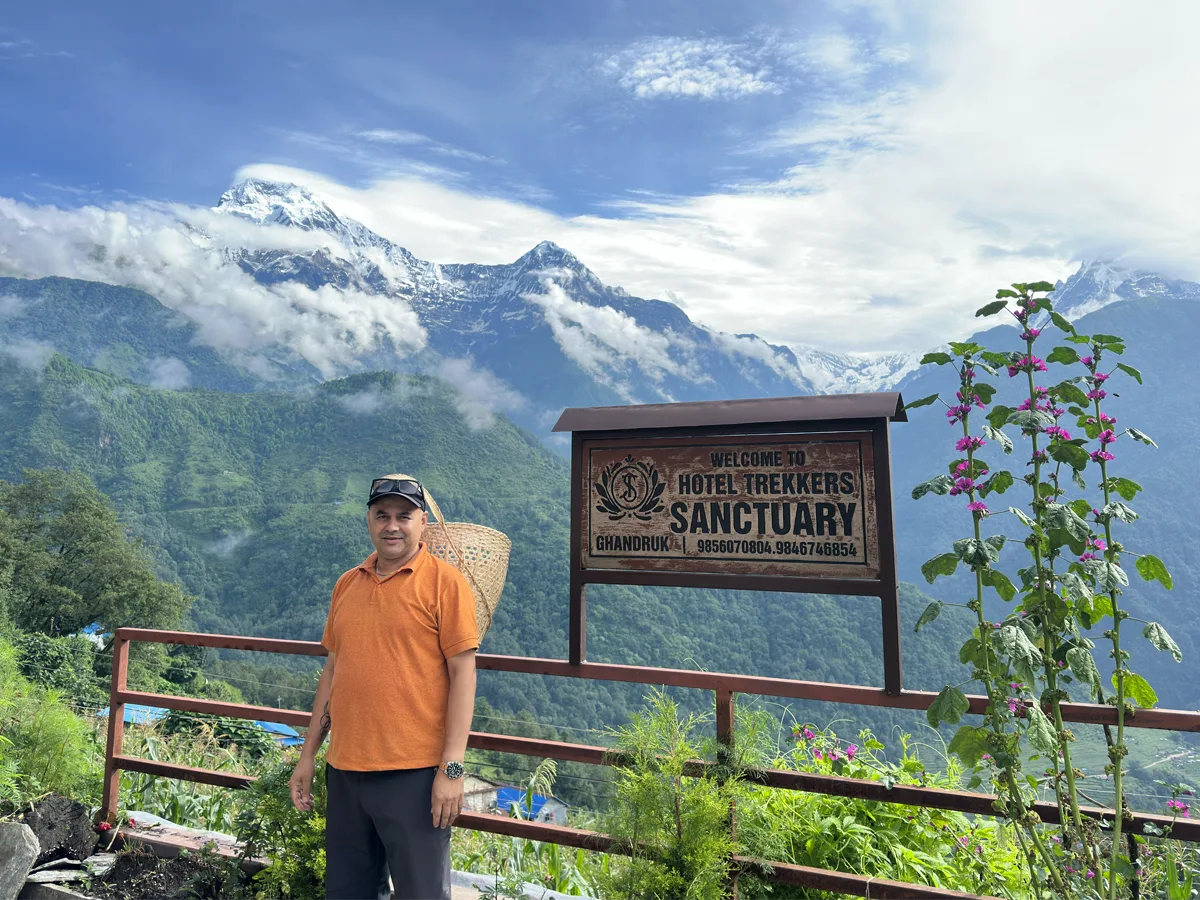
The route runs through Gurung and Magar villages including Ghandruk and Chhomrong, where stone houses and prayer flags sit against a backdrop of Machhapuchhre (Fishtail Mountain), a peak so sacred it has never been officially summited. Along the way, hot springs at Jhinu Danda give trekkers a genuinely welcome place to soak tired legs after the final push to base camp.
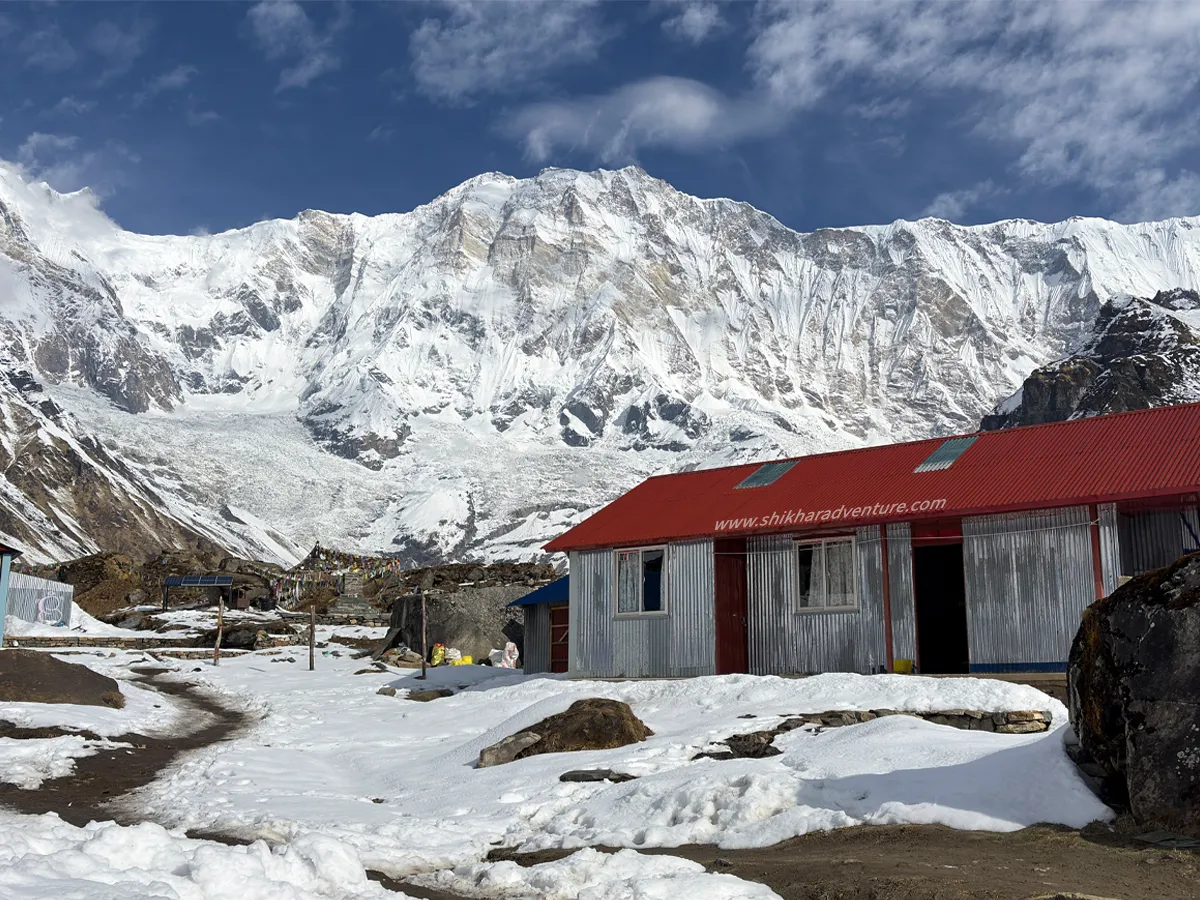
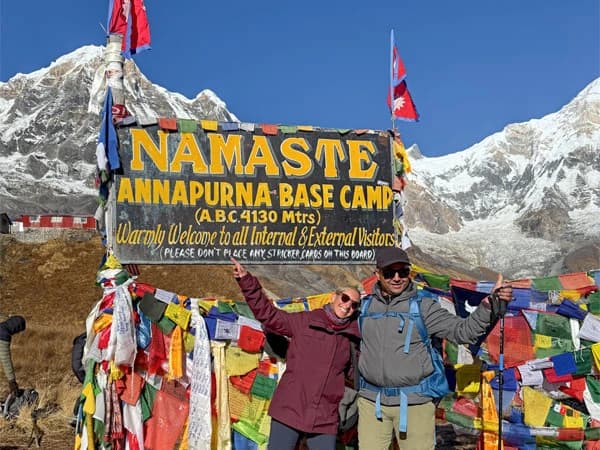
Base camp itself sits at 4,130 m (13,549 ft), directly beneath the south face of Annapurna I, one of the most technically demanding 8,000-meter peaks in the world. Standing there at sunrise, watching the light hit the surrounding wall of ice and rock, is one of the more overwhelming moments on any Nepal trek.
Annapurna Base Camp, surrounded by peaks on all sides.
What to expect
Permits: Annapurna Conservation Area Permit (ACAP).
Guide: Mandatory, in line with the 2023 rule.
Fitness: Moderate. Long uphill and downhill stretches, but no technical sections.
Altitude: Tops out at 4,130 m, low enough that most trekkers acclimatize comfortably with a sensible itinerary.
Best months: March to May and September to November.
Who should choose it: trekkers who want maximum scenic and cultural variety in a single week to ten days, without the altitude commitment of Everest Base Camp.
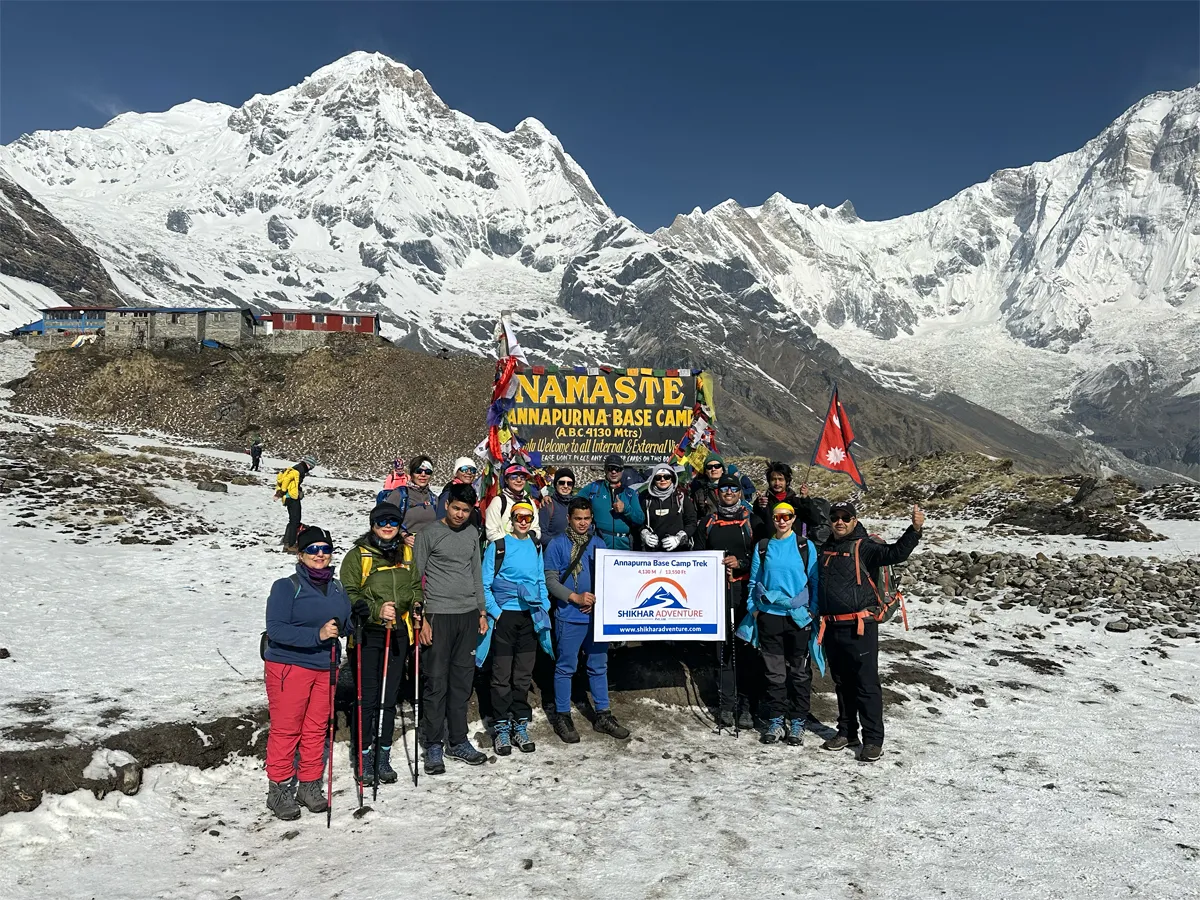
A trekking group making their way to Annapurna Base Camp.
Real Reviews from Our Annapurna Base Camp Trekkers
"This time, I chose to trek in Nepal during winter. I've been following trekking pages in Nepal on Facebook, and I noticed that Mr. Dambar Thapa, the owner of Shikhar Adventure, answers trekkers' questions very quickly and thoroughly, giving me a very professional impression.
So I messaged him to ask about the ABC and Mardi Himal combined trek itinerary. Dambar responded very quickly again, patiently answering all my questions in detail. Ultimately, I decided to join Shikhar Adventure for this trek alone.
Dambar arranged for Mr. Sun Bahadur to act as both guide and porter for me. During the 9-day trek, he was incredibly caring, like an older brother looking after a younger sister.
He always had a smile on his face, was humorous, and very approachable. His English was also fluent. He immediately introduced me to any unusual plants or animals we saw along the way.
Next time I trek in Nepal, I will definitely use Shikhar Adventure again to help with all the arrangements."
Alison Tam - Hong Kong (January, 2026)
3. Mardi Himal Trek
Mardi Himal has gone from a barely-known side trail to one of the Annapurna region's most requested treks in the space of a few years, and it's easy to see why. The route follows a narrow forested ridge rather than a valley floor, which means the views open up gradually and dramatically, rather than all at once at the very end.
Above the treeline, the trail runs along an exposed ridge with Machhapuchhre rising directly ahead and the Annapurna massif filling the skyline to the west. It is one of the better treks in Nepal for photography specifically, since the ridge walking gives you unobstructed angles that valley treks rarely offer.
At five to six days, it is short enough to fit into a single week away from work, and because it still sees far fewer trekkers than the main Annapurna trails, mornings at High Camp tend to be quiet.
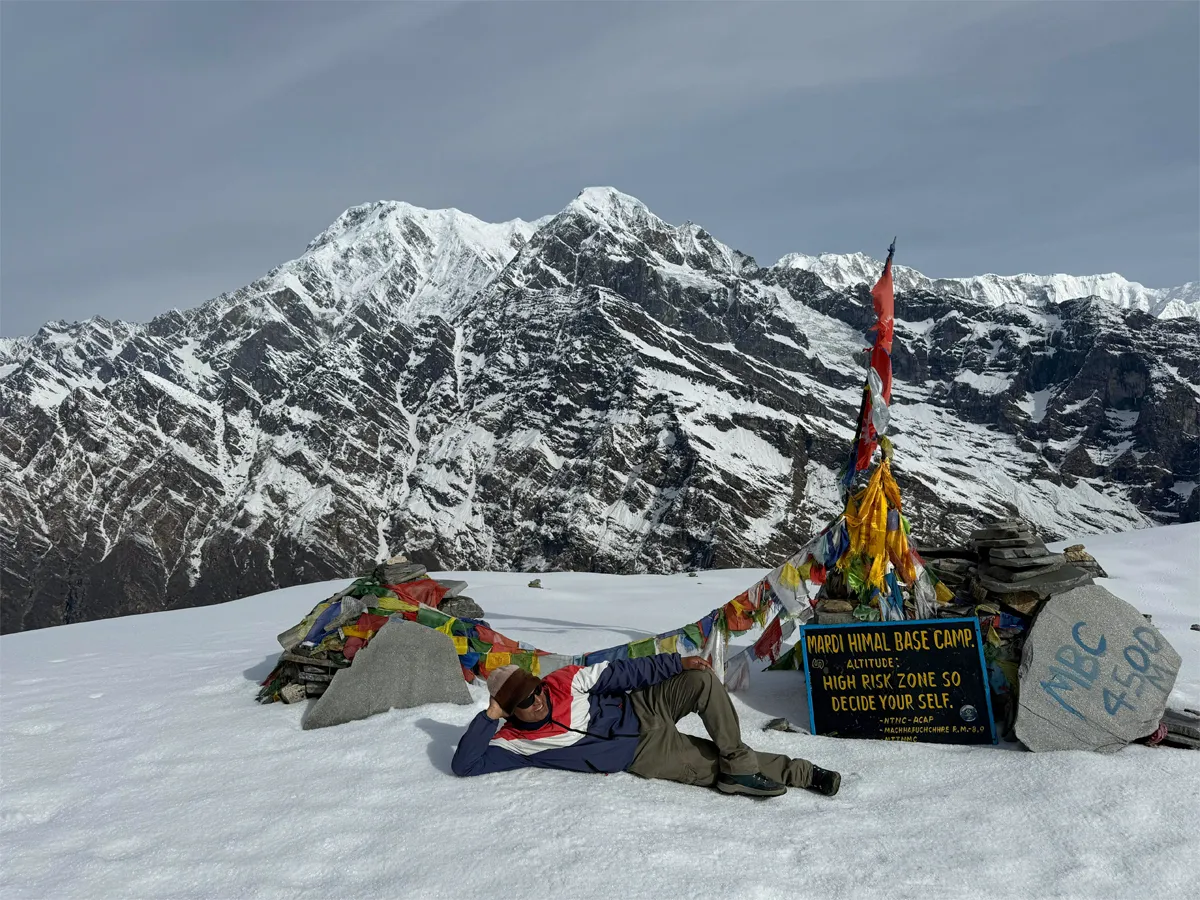
Mardi Himal Base Camp, one of the best treks for beginners.
What to expect
Permits: ACAP.
Guide: Mandatory.
Fitness: Moderate. Steep sections above High Camp, but no technical terrain.
Altitude: Base camp at 4,500 m (14,764 ft), viewpoint slightly lower at around 4,200 m (13,780 ft).
Best months: March to May, September to December.
Who should choose it: first-time trekkers who want a genuine high-altitude experience without a two-week commitment, and photographers who want ridge-line views without the crowds of the classic Annapurna trails.
Verified Review: Mardi Himal Trek with Shikhar Adventure
"An incredible experience trekking Mardi Himal and Annapurna Base Camp with Shikhar Adventure. Dambar handled every detail of planning, permits, flights, and gear with patience and constant communication. Our guide Sun was knowledgeable, caring, and endlessly positive on the trail. When I fell sick on the last day, he carried me on his back to get me to the jeep. Shikhar Adventure and Sun are a must for anyone trekking in Nepal." Read the full review
Jeff P - South Korea (April, 2026)
4. Manaslu Circuit Trek
If Annapurna Circuit is on your list but the crowds put you off, Manaslu Circuit is the trek most experienced guides will point you toward instead. It circles the eighth-highest mountain in the world through terrain and culture remarkably similar to Annapurna's, but because Manaslu is a restricted area requiring its own permit, it sees a fraction of the foot traffic.
The lower villages are Gurung and Hindu, but the trail shifts culturally as it climbs, and by the time you reach Samagaon and Samdo, you are walking through communities that are ethnically and culturally Tibetan, with monasteries, mani walls, and prayer flags marking a very different atmosphere from the trek's start. Buddhist tradition holds that the saint Milarepa once meditated in caves on Manaslu's slopes, and that history is still visible in the region's monasteries today.
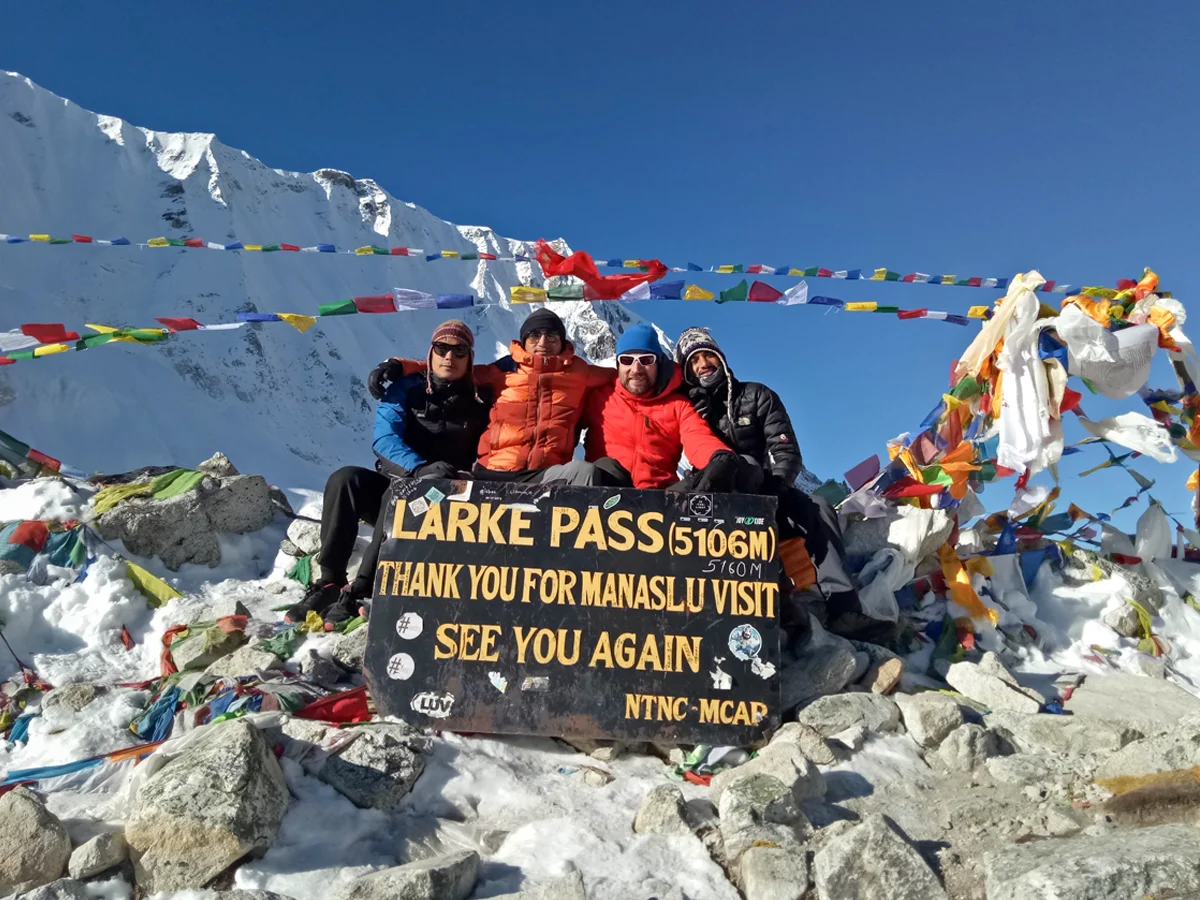
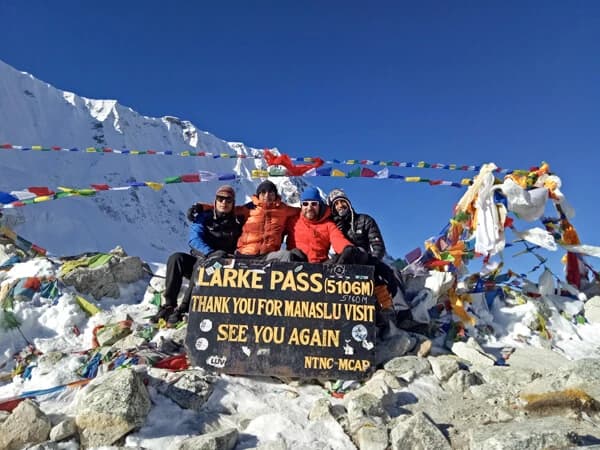
The trek's defining day is the crossing of Larke Pass at 5,106 m (16,752 ft), a long, demanding day that rewards you with views of Himlung Himal, Cheo Himal, and the western edge of the Annapurna range before dropping into Bimthang on the other side.
Larke Pass, the high point of the Manaslu Circuit at 5,106 m.
What to expect
Permits: Restricted Area Permit (RAP), Manaslu Conservation Area Permit (MCAP), and an ACAP entry for the final section near Dharapani.
Guide: Mandatory, with no exceptions, since this is a restricted area. As of March 2026, solo trekkers no longer need a second person to qualify for the permit, but the licensed guide and registered agency requirement stands.
Fitness: Good. This is a longer, more demanding trek than Annapurna Base Camp, with a serious high pass to cross.
Altitude: 5,106 m at Larke Pass. Build in proper acclimatization days at Samagaon and Samdo.
Best months: March to May and September to November.
Who should choose it: trekkers who've done a classic Annapurna or Everest route before and want a comparable experience with real solitude. For a full side-by-side, see our Manaslu Circuit vs. Annapurna Circuit guide.
Verified Review: Manaslu Circuit with Shikhar Adventure
"We had an amazing trekking experience in a beautiful part of Nepal. Dambar and his team were excellent from planning the trip to guiding us around the trekking circuit that was challenging but very rewarding.
Dambar was always conscious of our needs, extremely observant and safety was always first. I would highly recommend Shikhar Adventure for your Nepal trekking, this was the second trek we booked with them the first being Everest Base Camp with Cho La Pass and both have been excellent."
Mark Leader - UK (October, 2019)
5. Ghorepani-Poon Hill Trek
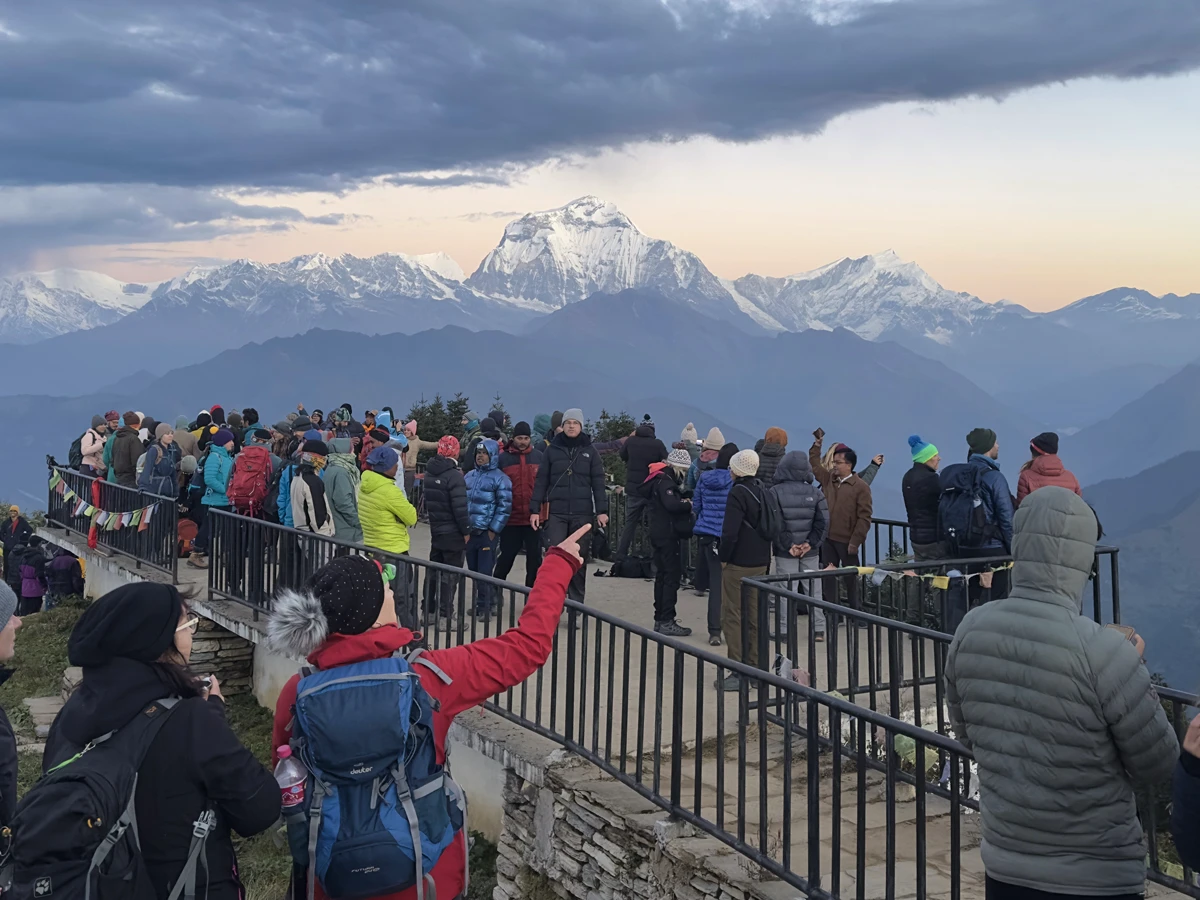
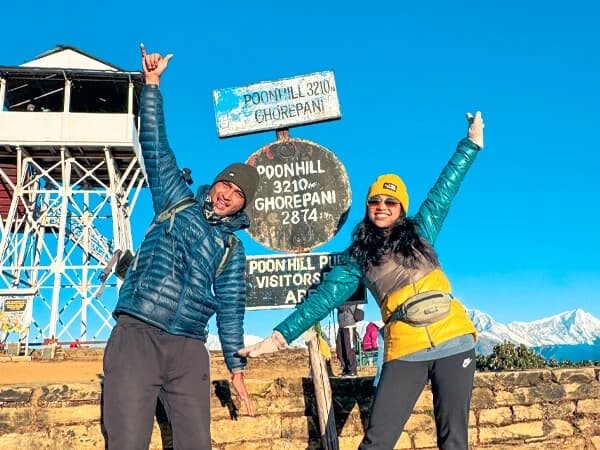
Every guide in Nepal has a trek they recommend to first-timers, and for most, it's this one. Ghorepani-Poon Hill takes four to five days out of Pokhara, climbs through some of the densest rhododendron forest in the Annapurna region, and ends with a pre-dawn walk to the Poon Hill viewpoint at 3,210 m (10,531 ft) for sunrise over Annapurna South, Dhaulagiri, and Machhapuchhre.
What makes it the standard beginner recommendation isn't just the low altitude, it's the trail itself. Stone steps and clear paths connect Gurung and Magar villages like Ghorepani and Ghandruk at a gentle daily pace, with teahouses close enough together that nobody is ever more than a couple of hours from a hot meal and a bed.
If you're pressed for time, a shorter three to four day version focused purely on Poon Hill is available through our Poon Hill Trek from Pokhara.
Sunrise over Mt. Dhaulagiri from Poon Hill.The Ghorepani-Ghandruk trail winds through Gurung villages and terraced hills.
What to expect
Permits: ACAP.
Guide: Mandatory.
Fitness: Easy to moderate. Well-graded stone stairways, no technical terrain.
Altitude: Tops out at 3,210 m, low enough that altitude sickness is rarely a concern.
Best months: Trekkable most of the year, best from October to April.
Who should choose it: first-time trekkers, families, and anyone with four or five days who wants a genuine Himalayan sunrise without the altitude or time commitment of a longer trek.
Real Reviews from Our Ghorepani Poon Hill Ghandruk Trekkers
"Our first Himalayan trek, Poon Hill, fully customized for our family with two young children aged 1.5 and 4. Shikhar Adventure planned the daily distances perfectly for us.
Our guide Sun Bahadur created a warm, family-oriented atmosphere and was always ready to help, from carrying our child carrier to handing us trekking poles.
Our boys grew close to our porter too, who played with them throughout the trek. A wonderful experience we wholeheartedly recommend." Read the full review
Justyna Nowak - Poland (May, 2026)
Bonus trek: Langtang Valley
If you've already completed one of Nepal's classic treks, Langtang Valley is one of the most rewarding alternatives, and one of the closest to Kathmandu. The drive to the trailhead takes only a few hours, which makes Langtang the trek of choice for anyone short on time who still wants a full Himalayan experience.
The valley was badly affected by the 2015 earthquake, and the region's recovery is itself part of what makes trekking here worthwhile: villages have rebuilt, teahouses are open, and trekking tourism directly supports communities that lost a great deal. The trail passes through Tamang villages, a yak cheese factory at Kyanjin Gompa, and views of Langtang Lirung rising above the valley at 3,870 m (12,697 ft) at the trek's high point.
What to expect
Permits: Langtang National Park entry permit.
Guide: Mandatory.
Fitness: Moderate.
Altitude: 3,870 m, comfortably lower than the other treks on this list.
Best months: March to May and September to November.
Who should choose it: anyone who wants a second or third Nepal trek without dedicating two full weeks to it, and travelers who want their trip to directly support a community still rebuilding after 2015.
Verified Review: Langtang Valley with Shikhar Adventure
"We completed the Langtang trek with Shiktar Adventures and it has been truly an amazing experience.
Dambar, the owner, personally guided us with real dedication and professionalism — always attentive, always helpful, very knowledgeable of the area and always keen to share Nepalis culture and trekking stories and tips!
We had a great time from start to finish, and the price was also surprisingly good compared to other agencies. The trek was very well organised, including transport and bookings for all the lodges and meals!
If anyone is planning a trek in Nepal, I can genuinely recommend them! They not only provide support for the Langtang trek, but also for many other routes allover Nepal!"
Giulia R - Italy (November, 2025)
Which trek is best for you?
You are
Best trek
Why
A first-time trekker
Ghorepani-Poon Hill or Mardi Himal
Low altitude, well-graded trails, short enough to test whether trekking is for you
The Cho La Pass crossing and Gokyo Lakes add real challenge to an already iconic route
Chasing the best scenery in one trip
Annapurna Base Camp
The single greatest variety of forest, village, and high-mountain scenery on any short Nepal trek
Short on time (under a week)
Mardi Himal or Ghorepani-Poon Hill
Both fit into 5 to 6 days including Pokhara travel time
An experienced trekker wanting a real challenge
Manaslu Circuit
A demanding high pass, restricted-area remoteness, and multi-week duration
Trying to avoid crowds
Manaslu Circuit or Langtang Valley
Both see a fraction of the trekkers that Everest and Annapurna's classic routes do
Practical advice for trekking in Nepal
A few things surprise first-time trekkers more than anything else, so it's worth covering them here rather than leaving you to find out on the trail.
Altitude sneaks up on people who feel strong. Fitness reduces your risk of AMS, but it doesn't remove it. The trekkers who struggle most are often the ones who feel great early on and push their pace above 3,500 m. Build acclimatization days into your itinerary regardless of how fit you are, and tell your guide immediately if you develop a headache, nausea, or unusual fatigue.
Wi-Fi and charging cost extra almost everywhere above 3,000 m. Most teahouses on these five routes have Wi-Fi and charging available for a small fee, generally more reliable on Everest and Annapurna routes than on Manaslu or Langtang. A power bank is worth carrying regardless.
Food is simple, filling, and repeats a lot. Dal bhat, the Nepali staple of lentils, rice, and vegetable curry, is the trekking world's best value meal: most teahouses offer free second helpings, and it's genuinely the best fuel for a long day's walk.
Pack for a 20-30 degree Celsius temperature swing in a single day. Mornings and evenings above 3,000 m can drop well below freezing even in peak season, while midday sun on an exposed trail can be surprisingly warm. Layering matters more than any single piece of gear.
The most common mistake is underbudgeting for extras. Hot showers, Wi-Fi, battery charging, and bottled or boiled water all cost a few extra dollars a day at altitude, and they add up. Budget for them from the start rather than being surprised on day six.
Why trekking with a licensed, registered guide matters
Every route on this page requires a licensed guide, and beyond the legal requirement, there's a practical reason to take it seriously: a good guide is your fastest route to help if something goes wrong at altitude, your best source of accurate trail and weather information, and often the reason a trek's small revenue actually reaches the people who live along it. Choosing a registered trekking company with TAAN-affiliated guides and fair porter practices, rather than the cheapest unlicensed operator you can find, is one of the few decisions on a Nepal trek that genuinely affects both your safety and the community you're walking through.
Frequently asked questions
How difficult is trekking in Nepal?
It ranges widely. Ghorepani-Poon Hill and Mardi Himal are achievable for most reasonably fit beginners. Everest Base Camp and Manaslu Circuit are more demanding, requiring good fitness and multi-day stamina, though neither requires technical climbing skill.
Which trek is best for beginners?
Ghorepani-Poon Hill. It stays below 3,210 m, follows well-graded stone trails, and passes through villages frequently enough that a tired trekker always has an easy option nearby.
What is the most beautiful trek in Nepal?
Most guides would say Annapurna Base Camp for sheer variety of scenery in a short trip, or Everest Base Camp via Gokyo for the single most dramatic high-altitude panorama.
When is the best season to trek in Nepal?
Late September to November and March to May are the two main trekking seasons, offering the clearest skies and most stable weather. Each month within those windows has its own trade-offs on temperature, crowds, and trail conditions.
Can beginners do Everest Base Camp?
Yes, with the right preparation. It's a longer and higher trek than a true first-timer route, but trekkers with no prior high-altitude experience complete it successfully every season, provided they train beforehand and follow a properly paced itinerary with acclimatization days built in.
How much does trekking in Nepal cost?
It depends heavily on route and service level. A standard guided Everest Base Camp trek typically runs USD 1,300 to 2,000. Restricted-area treks like Manaslu tend to cost more per day due to permit fees, despite seeing far fewer trekkers.
Do I need a guide to trek in Nepal?
Yes, for most trekking areas, a rule in place since 2023. Restricted areas including Manaslu, Upper Mustang, Upper Dolpo, and Kanchenjunga have always required one, with no exceptions. Enforcement is looser in some open areas, but we don't recommend going without one.
How many days should I plan for a Nepal trek?
Anywhere from 4 days for Ghorepani-Poon Hill to 3 weeks or more for the most remote restricted-area treks. Most first-time visitors plan 10 to 14 days to allow for one major trek plus a few days in Kathmandu or Pokhara.
Which trek has the fewest crowds?
Manaslu Circuit sees roughly an eighth of Annapurna's annual trekker numbers, and Langtang Valley, despite its proximity to Kathmandu, still sees far fewer trekkers than the main Everest and Annapurna trails.
Ready to plan your trek?
Every trek on this page is one we operate regularly. Tell us your dates, your fitness level, and what you want out of the trip, and we'll give you an honest recommendation, even if that means telling you a different trek suits you better.