The first thing we tell trekkers after they land in Lukla is to slow down and not rush the walk to Phakding. Kathmandu sits at around 1,400m. Lukla is already at 2,860m. You have just gained nearly 1,500m in a 25-minute flight, and your body has not caught up. This page covers everything trekkers need to know about Lukla before they arrive: altitude, the airport, how flights work, what to do if the flight is cancelled, and what the town itself is actually like.
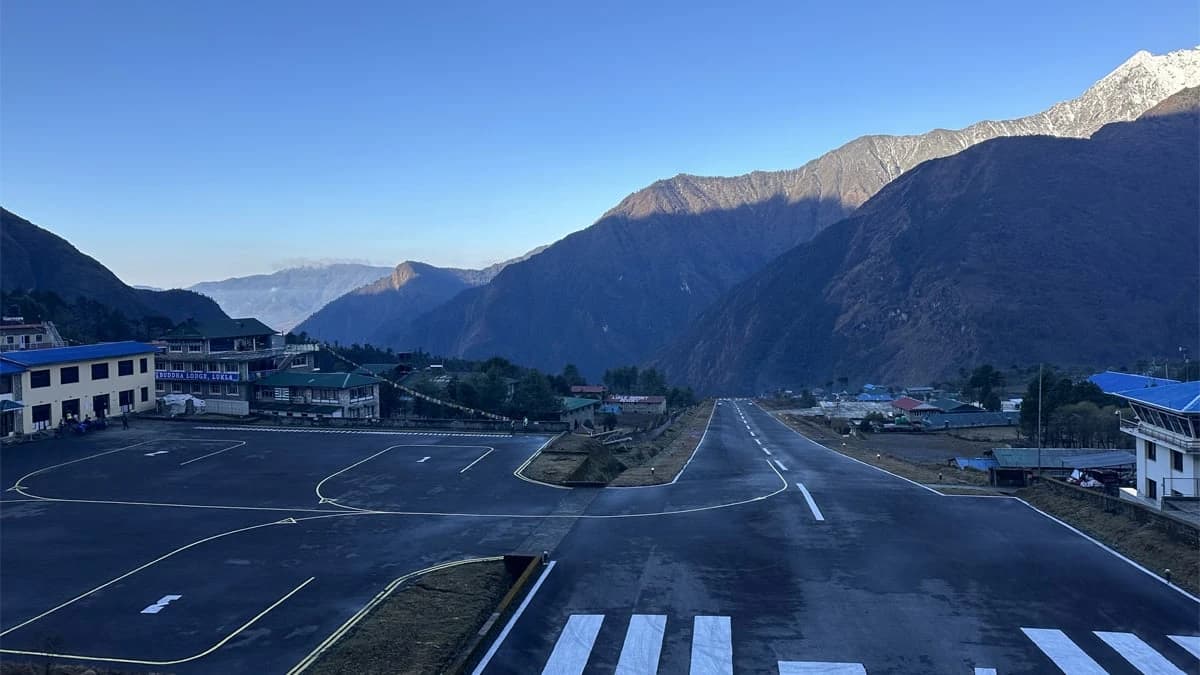
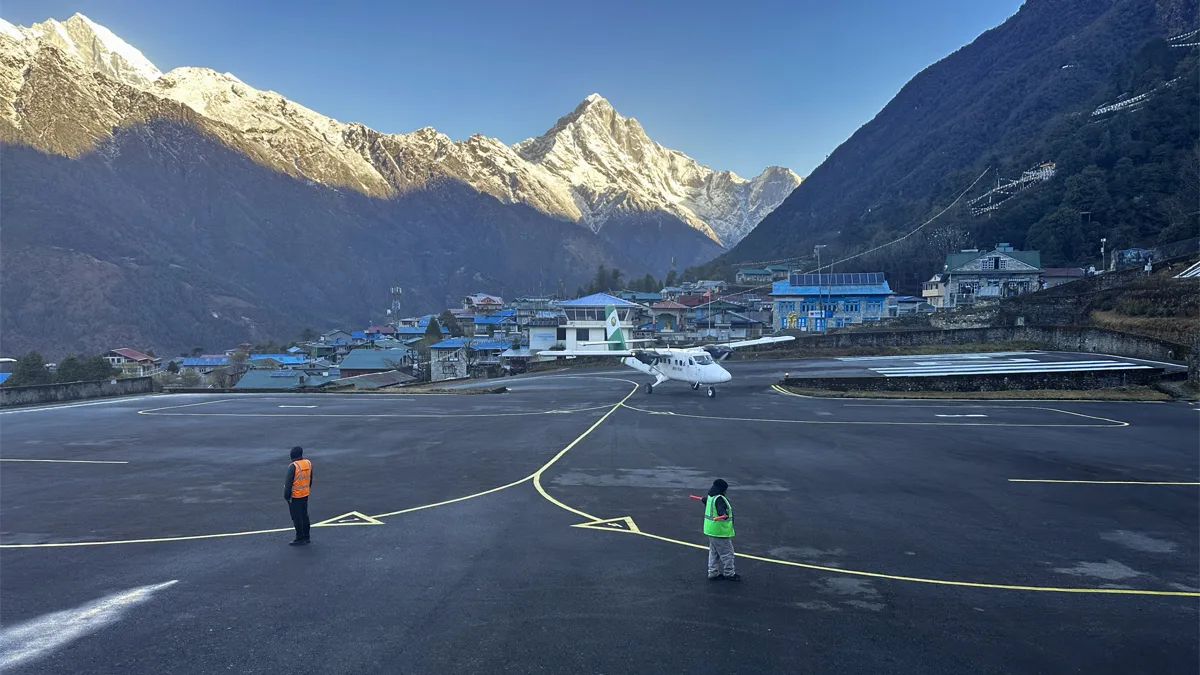
Tenzing-Hillary Airport, Lukla. The 527m runway ends at a cliff edge on one side and a mountain wall on the other. Named after Sir Edmund Hillary and Tenzing Norgay Sherpa.
Where is Lukla and what is its altitude?
Lukla is at 2,860m (9,383ft) in the Solukhumbu District, Koshi Province, Nepal. It sits at the lower entrance to the Khumbu Valley and serves as the start and end point of every major Everest region trek operated by Shikhar Adventure.
Kathmandu is at approximately 1,400m. The flight to Lukla covers that altitude difference in about 25 minutes. Your cardiovascular system begins adjusting from the moment you land, which is why the first day's walk matters. The trail from Lukla descends initially toward Phakding, which actually helps with the first altitude exposure.
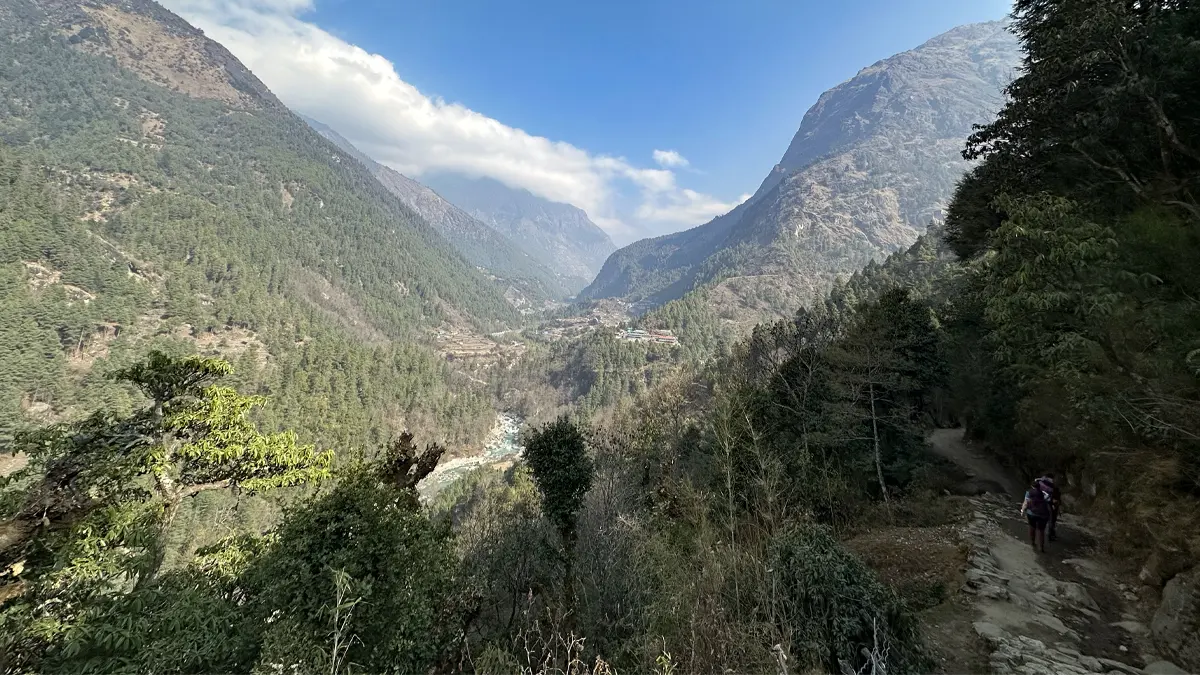
From Lukla, the next stop on the Everest Base Camp route is Phakding, 6.2km (3.9 miles) away on a trail that takes 3 to 4 hours at a comfortable pace. Most groups reach Phakding by early afternoon and have the rest of the day to rest before the longer climb toward Namche Bazaar the following morning.
Lukla is a working Sherpa town, not just an airport.
How do you get to Lukla from Kathmandu or Manthali?
All trekkers fly to Lukla. The flight takes 25 to 35 minutes depending on conditions. Where you depart from depends on the season.
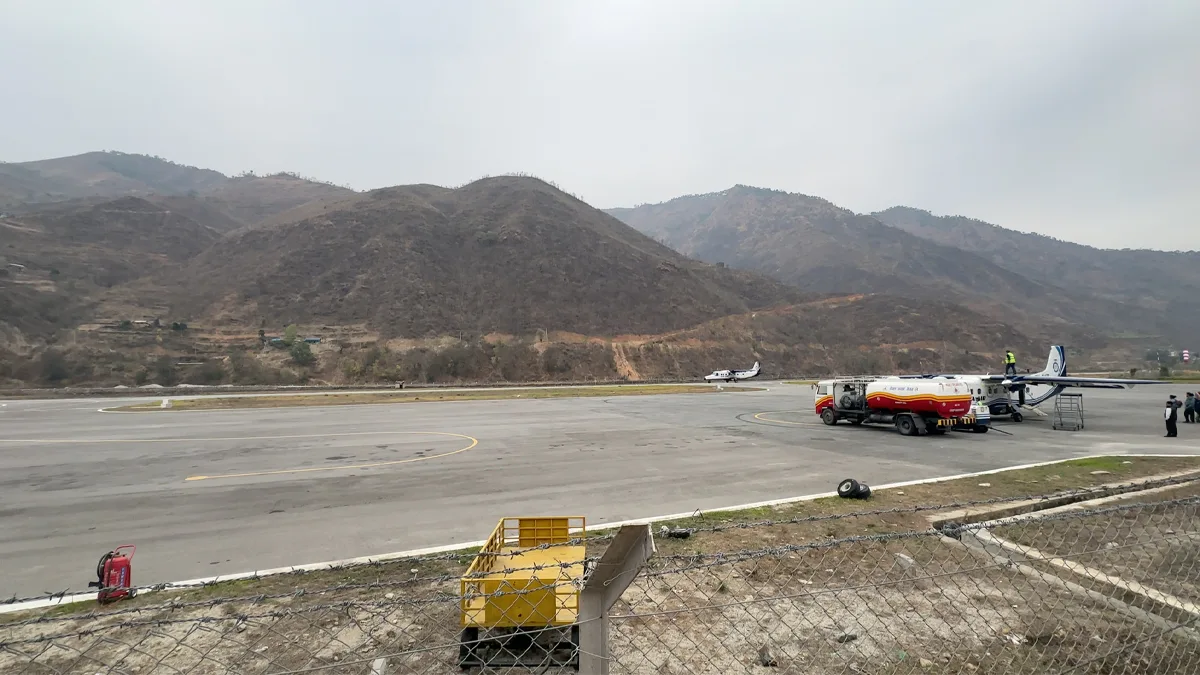
During peak trekking seasons, March to May and late September to November, flights to Lukla operate from Manthali Airport in Ramechhap, not from Kathmandu's Tribhuvan International Airport. The Civil Aviation Authority of Nepal moved peak-season Lukla departures to Manthali to reduce congestion at the main airport. Outside these windows, flights go directly from Kathmandu.
Manthali is 132km from Kathmandu by road, a drive of 3.5 to 4 hours. During peak season, most Shikhar Adventure groups leave their Kathmandu hotel at 1 to 2am to reach Manthali in time for early morning departures. Roads are clear at that hour and the drive is straightforward, but the early wake-up comes on top of pre-trek preparation and can add to fatigue. We always brief clients on this the day before and confirm pickup time during the pre-trek meeting.
Lukla flights operate under visual flight rules only. Pilots need clear line-of-sight to the runway at all times. Cloud, fog, and strong wind are the three conditions that cancel flights. Morning weather in the Khumbu is typically cleaner than afternoon, which is why almost all flights depart before 10am and why a scheduled flight can be cancelled at the gate even after you have driven 4 hours to Manthali.
Weather cancellations are a real operational risk, not a theoretical one. In peak season, it is common to see 1 to 3 days of consecutive cancellations due to persistent cloud over the Lukla approach corridor. We keep all clients informed in real time through their assigned guide, who monitors conditions and coordinates directly with the airline handling agents at Manthali or Kathmandu.
When flights are grounded and the weather window is uncertain, helicopter sharing becomes the practical option. A shared helicopter seat to Lukla costs approximately USD 500 to 1,200 per person depending on the number of passengers and current demand. A private charter for 5 passengers runs around USD 2,800 total. We pre-identify helicopter operators we have working relationships with so that when a group needs to move, the coordination happens quickly rather than trekkers scrambling independently at a busy airport.
The practical rule we give every client: build at least two buffer days into the end of your Nepal trip before your international departure. Do not schedule a flight home the day after you are supposed to land in Kathmandu from Lukla. One weather cancellation can cascade into two nights in Lukla and a missed connection.
The night before your Lukla flight, keep your passport and boarding documents in a top pocket you can access without unpacking. Have your down jacket in your carry-on bag. The airport is cold before dawn, and the flight itself is cold regardless of season.
132km from Kathmandu. Most groups leave their hotel at 1 to 2am.
Tenzing-Hillary Airport: what the runway and arrival are actually like
Tenzing-Hillary Airport is named after Sir Edmund Hillary and Tenzing Norgay Sherpa, the first two people to reach the summit of Everest in 1953. The airport was constructed at Hillary's initiative and opened in 1964 to supply the region with goods and connect the Sherpa community to Kathmandu.
The runway is 527m (1,729ft) long and sits on an 11.7-degree uphill gradient. On landing, aircraft touch down at the lower end and brake uphill. On take-off, aircraft roll downhill and become airborne at the edge of a cliff. The airport operates entirely on visual flight rules, meaning pilots need direct line of sight to the runway at all times.
There is no instrument landing system and no overshoot facility. As Pradip Bashyal, a BBC journalist who has written about Nepali aviation, documented: once a pilot crosses the no-go point on approach, the landing must be completed. There is no second approach. Pilots flying Lukla routes hold a specialist mountain flying certification and operate a fleet of small Twin Otter or similar short take-off aircraft. The combination of short runway, gradient, cliff exposure, and no abort facility makes this technically one of the most demanding commercial runways in regular use.
The arrival experience itself is low-key. The terminal building is small. You collect any checked luggage within a few minutes of landing. Your Shikhar Adventure guide will be waiting just outside the terminal with a sign. The first task is a gear check: boots, layers, daypack organisation, and making sure trekking poles are accessible before you start walking. The whole process from landing to starting the trail takes about 30 to 45 minutes.
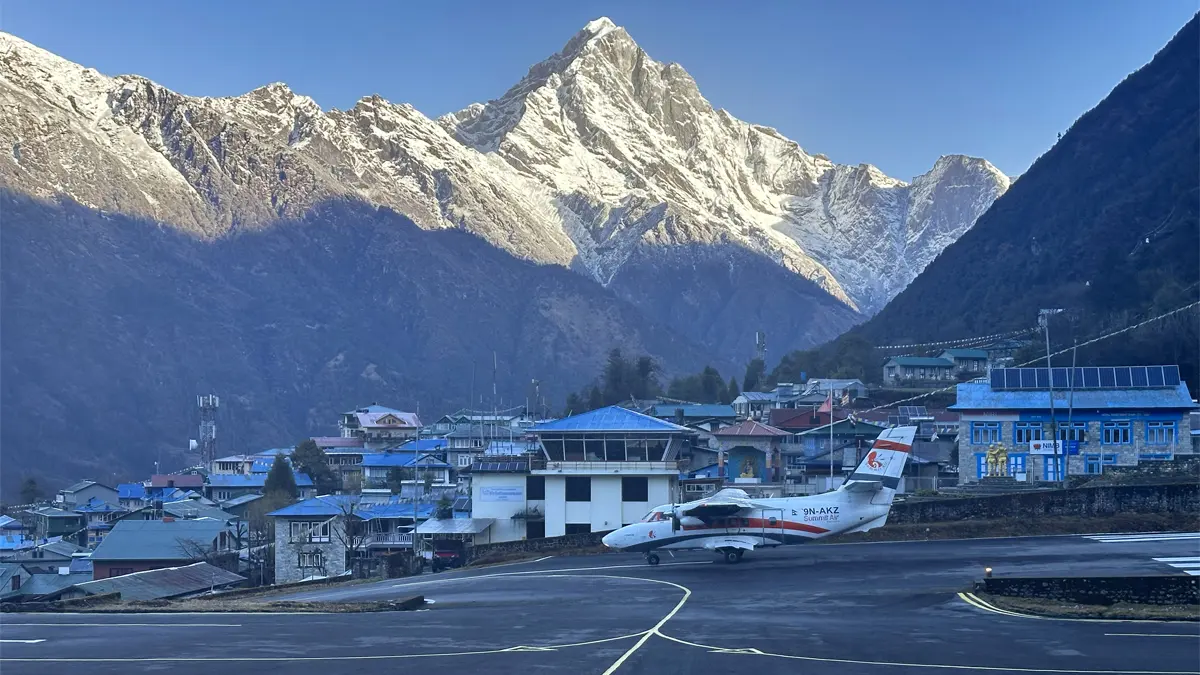
Twin Otter aircraft on Lukla runway - Taking Off
Lukla town: what it is and what most trekkers miss on arrival day
Most trekkers walk straight through Lukla on arrival day because the itinerary continues to Phakding. The irony is that the return evening in Lukla, when the trek is over and the flight home is the next morning, is often the first time people actually see the town.
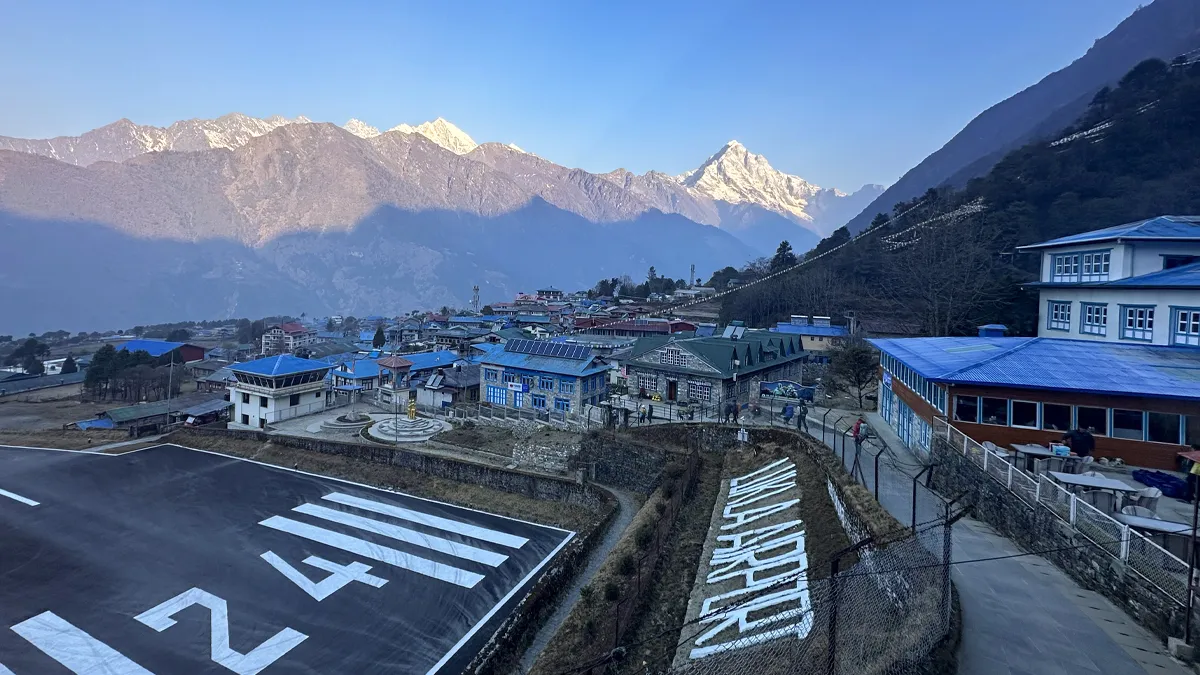
Lukla is a working Sherpa town, not just an airport. The main street runs from the airport gate toward the trail heading north and is lined with bakeries, tea houses, restaurants, gear shops, and small lodges. You can get a proper meal, a decent espresso, and fresh bread before 7am on departure day. Several shops sell and rent trekking equipment, though prices are higher than Kathmandu and selection varies.
On the upward journey, trekkers land and continue to Phakding without spending the night. The altitude gain from Kathmandu has already happened during the flight, and continuing downhill to Phakding at 2,610m is actually beneficial. There is nothing to be gained from overnighting in Lukla on arrival.
On the return, one night in Lukla before the flight is standard. This is a genuinely useful evening. The trek is finished, the altitude pressure is off, and trekkers have time to walk the town at their own pace, eat a meal that is not teahouse dal bhat, and sort their gear before packing for the flight. We usually have a short debrief with the group that evening and settle any outstanding logistics for the morning departure.
Accommodation and facilities in Lukla
Lukla has better accommodation facilities than anywhere else on the EBC route above it. Attached bathrooms, hot showers, reliable Wi-Fi, and device charging are available at most mid-range lodges. These are not guaranteed above Namche Bazaar at the same standard, so the return overnight in Lukla often feels significantly more comfortable than the preceding nights at altitude.
Wi-Fi at most Lukla lodges handles email and messaging without issues. Video calls are inconsistent but usually possible. Mobile data works on NTC and Ncell networks. Device charging is available at lodges, typically for a small fee per device.
The return overnight is also the practical time to reorganise gear. Anything rented from Kathmandu that needs to go back, souvenirs bought along the route, items that need repacking before the flight, and porter and guide payments all get handled this evening. We walk through the checklist with every group so that the morning departure is straightforward.
6.2km, 3 to 4 hours. The first walking section of the EBC route.
Lukla weather and the best seasons for flights
Spring, March to May, and autumn, late September to November, are the most reliable seasons for Lukla flights. These windows overlap with the main trekking seasons for good reason: the weather is more stable, visibility is cleaner, and morning flights have a higher completion rate.
Winter trekking, December to February, is possible and Lukla flights do operate, but cold temperatures, occasional snowfall on the approach corridor, and lower passenger volumes mean fewer daily flights and a higher chance of disruption. Temperatures in Lukla in January can drop well below zero before dawn.
The monsoon season, June to August, brings persistent cloud, rain, and reduced visibility across the Khumbu approach corridor. Flight cancellation rates are highest during this window. Most experienced guides do not recommend planning an Everest region trek during the monsoon unless the itinerary includes significant buffer days and a helicopter budget.
Morning is the only realistic window for Lukla flights regardless of season. Thermal activity builds through the morning and cloud typically moves into the valleys by 10 to 11am. Almost all scheduled departures are before 9am. If a flight does not get away by mid-morning, it is unlikely to go that day.
Treks that start and end in Lukla
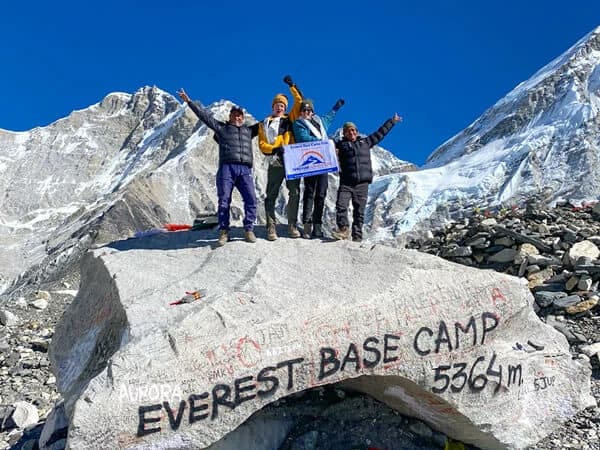
Everest Base Camp Trek (14 Days) — The standard Khumbu route to 5,364m. Suits trekkers with reasonable fitness and no technical experience. Two acclimatization days built in.
Everest Base Camp Helicopter Return (12 Days) — Treks in via Lukla, helicopters back to Kathmandu from Gorak Shep. Saves 2 to 3 days on the return and avoids the Lukla flight on the way back.
Gokyo Lakes Trek (14 Days) — Reaches the Gokyo Valley and Gokyo Ri at 5,357m instead of Base Camp. Fewer trekkers on trail, comparable altitude.
Three Passes Trek (18 Days) — Crosses Kongma La (5,535m), Cho La (5,420m), and Renjo La (5,340m). The most complete Khumbu circuit. Requires strong fitness and prior high-altitude experience.
Common questions about Lukla
Is the Lukla flight actually dangerous?
Yes, Tenzing-Hillary Airport is genuinely one of the most technically demanding commercial airports in regular operation. The runway is 527m (1,729ft) long, built on an 11.7-degree gradient at the edge of a cliff, and has no overshoot facility. Once a pilot crosses the no-go point on approach, the landing must be completed. There is no second chance.
What happens if my Lukla flight is cancelled?
Keep at least two buffer days after your trek ends and before your international departure. If your flight is cancelled due to weather, Shikhar Adventure keeps helicopter options on standby and your guide coordinates the alternatives directly. Helicopter sharing from Lukla to Kathmandu costs approximately USD 500 - 600 per person. This is an additional cost not included in the standard trek package.
Do I fly to Lukla from Kathmandu or Manthali?
During peak seasons, March to May and September to November, flights operate from Manthali Airport in Ramechhap, 132km and 3.5 to 4 hours from Kathmandu by road. Outside peak season, flights go from Tribhuvan International Airport in Kathmandu. We handle the Manthali transfer as part of every peak-season departure.
Can I trek to Lukla instead of flying?
Yes. The most established overland route is via Jiri, adding 7 to 9 days to the trek from Kathmandu. It provides gradual altitude gain and significant additional acclimatization before reaching Namche. A faster option is to drive to Surke and trek the remaining distance to Lukla. Both approaches avoid the flight entirely and are available as part of our Everest Base Camp Trek from Jiri (21 Days).
How much does a helicopter from Lukla cost?
A private helicopter between Kathmandu and Lukla costs approximately USD 2,800 for up to 5 passengers. Shared seats cost approximately USD 500 to 600 per person. Shikhar Adventure coordinates shared helicopter arrangements for groups who need to move quickly due to flight cancellations or schedule changes.
How many nights do trekkers spend in Lukla?
On the standard itinerary, no overnight stay in Lukla on arrival. Trekkers land, meet the guide, complete a gear check, and continue to Phakding (6.2km / 3.9 miles, 3 to 4 hours). On the return, one night in Lukla is standard before the morning flight. Weather delays can extend this to two or more nights, which is why buffer days matter.
Practical advice from operating more than 100 Everest region trips
Build two buffer days at the end. Do not book an international flight home the day after your expected Kathmandu arrival from Lukla. One weather cancellation removes that margin entirely.
Keep your passport in a top pocket. It is checked at the Manthali or Kathmandu departure gate, at the Lukla terminal on return, and sometimes at trek checkpoints. It should be accessible without opening your main pack.
Pack all medications in your carry-on bag. Checked luggage occasionally gets delayed when flights are rescheduled. Altitude medication, a first aid kit, and any prescription drugs go in the bag that stays with you.
Expect schedule changes and plan for them. Lukla flight times shift frequently based on weather windows. The guide will notify you the evening before. Assume flexibility is required, not exceptional.
Avoid alcohol the night before the Manthali departure. You will be waking up at midnight or 1am after the trek briefing day. A clear head and good hydration matter more than a celebration dinner on that specific evening.
Keep your down jacket in your hand luggage. Manthali Airport and Lukla are cold before sunrise. Your down layer should not be packed inside a checked duffel that goes in the hold.
Do not rush the first hour after landing. Sit down, drink water, let the guide run the gear check at a normal pace. You have just gained 1,460m in altitude during the flight. The trail to Phakding is not going anywhere.
Cloud moves in by 10 to 11am. Almost all flights depart before 9am.
What Lukla means for your Everest region trek
Lukla is where every Everest region trek begins and where it ends. It is a small Sherpa town at 2,860m with a technically demanding airport, weather-dependent flights, and a main street that most trekkers walk through twice in 14 days. Understanding how it works operationally changes how you prepare for it.
The flight itself is short and the conditions that cancel it are the same conditions that make the mountains around it worth visiting. Weather is the variable you plan around, not the thing that surprises you mid-trip. Two buffer days, a helicopter budget as a contingency, and a guide who handles logistics on the ground are the three things that make the Lukla transition manageable regardless of conditions.
The return overnight matters more than most trekkers expect when they book. After 12 or 14 days at altitude, a night in Lukla with a hot shower, a proper meal, and a comfortable bed before the morning flight is not a minor logistical stop. It is a genuinely useful transition point between the mountain and the journey home.
We have run more than 100 Everest region departures through Lukla. The practical reality is that the flight goes smoothly the majority of the time and the airport is significantly less alarming in person than the internet suggests. What matters is having the right structure around it: correct timing, a guide who knows the system, and a schedule that absorbs the weather.