Everest Base Camp is the most-attempted high-altitude trek in the world. It requires no mountaineering skills. It reaches 5,364m (17,598ft) across 14 days of walking through the Khumbu Valley. This guide covers what people actually ask before booking: altitude, distances, permits, costs, packing, and what to do if something goes wrong.
What altitude is Everest Base Camp and where exactly is it?
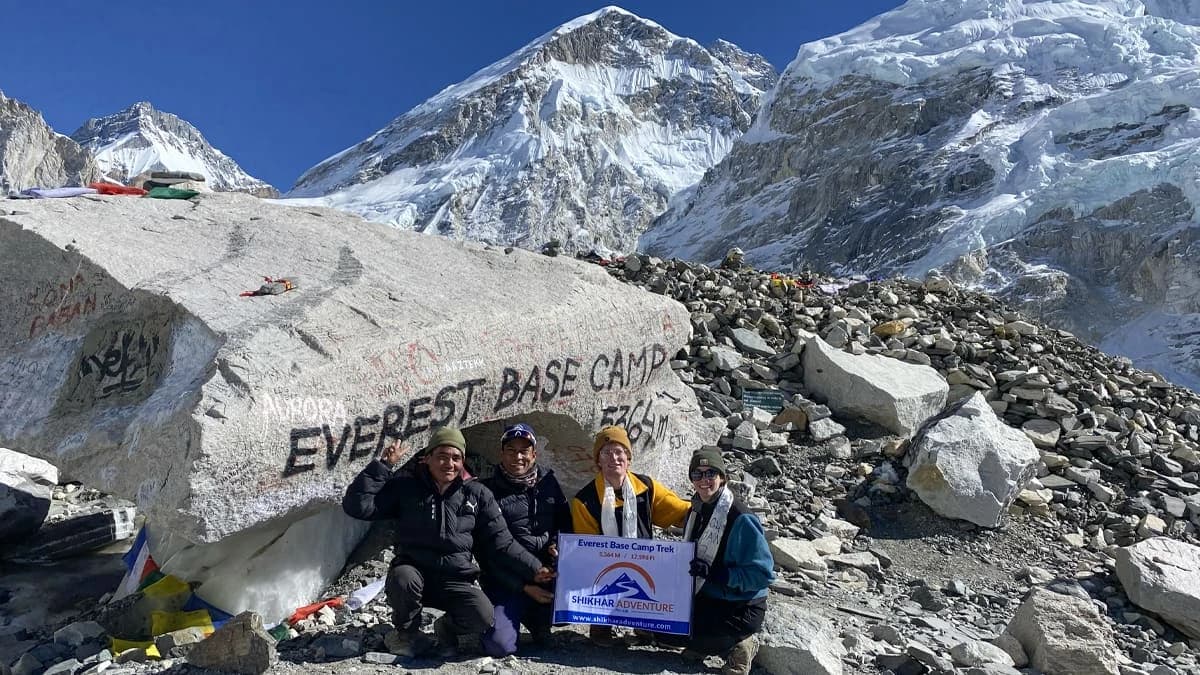
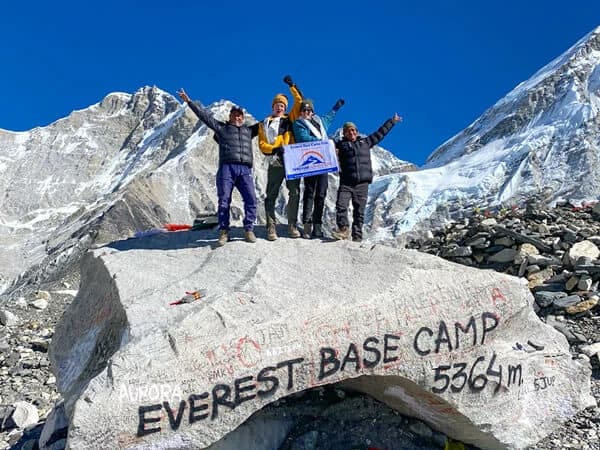
Everest Base Camp sits at 5,364m (17,598ft) on the right lateral moraine of the Khumbu Glacier, within Sagarmatha National Park, Solukhumbu District, Nepal. Coordinates: 28.0025°N, 86.8528°E.
There is a second Base Camp on the Tibet (north) side at 5,150m (16,896ft). When people refer to trekking to Everest Base Camp, they always mean the Nepal side.
Key fact
Detail
Base Camp altitude
5,364m (17,598ft)
Highest trekking point
Kala Patthar, 5,545m (18,192ft)
Highest sleeping altitude
Gorak Shep, 5,164m (16,942ft)
Net elevation gain from Lukla
2,504m (8,215ft)
Cumulative gain (full trek)
~7,300m (23,950ft)
Round trip distance
~130km (80mi) from Lukla
Nearest teahouse settlement
Gorak Shep, 3.5km (2.2mi) at 5,164m (16,942ft)
National park
Sagarmatha National Park (UNESCO World Heritage Site)
How far is Everest Base Camp? Stage-by-stage distances from Lukla
The round trip from Lukla to Base Camp and back is approximately 130km (80 miles). One way is 65km (40 miles), covered over 8 walking days. Daily distance ranges from 8km (5mi) on short days to 18km (11mi) on the long descent back to Lukla.
Distance does not reflect effort. A 10km (6mi) day above 4,500m (14,764ft) takes the same time as 16km (10mi) at lower altitude. Above 4,000m, most groups move at 2 to 3km per hour. Plan every day around altitude gain and walking hours, not kilometres.
What is the EBC route and what do you pass through?
The route follows the Dudh Koshi River valley north from Lukla (2,860m / 9,383ft) through a chain of Sherpa villages stepping up in altitude toward the Khumbu Glacier.
Day one descends to Phakding (2,610m / 8,563ft). This is deliberate. It eases the body into movement after the altitude jump during the Lukla flight. Day two brings the hardest single climb of the first half: 11km (6.8mi) to Namche Bazaar (3,440m / 11,286ft), gaining 830m (2,723ft) with the final 3km (1.9mi) climbing steeply to town.
Two nights in Namche follow. The rest day hike climbs to the Everest View Hotel at 3,880m (12,730ft) and returns. This is the first application of the climb-high-sleep-low acclimatisation method used across the full itinerary.
Above Namche, the trail reaches Tengboche Monastery (3,860m / 12,664ft), the largest monastery in the Khumbu, founded in 1916. Then Dingboche (4,410m / 14,469ft) for the second acclimatisation day, hiking to Nagarjun Hill at 5,100m (16,732ft) before sleeping lower.
From Dingboche, the trail passes the Thukla Pass memorial at 4,830m (15,846ft), where stone cairns mark climbers and Sherpas lost on Everest. It is the most culturally significant section of the route. From Lobuche (4,940m / 16,207ft), the Khumbu Glacier moraine leads to Gorak Shep (5,164m / 16,942ft), then 3.5km (2.2mi) of shifting rock to Base Camp.
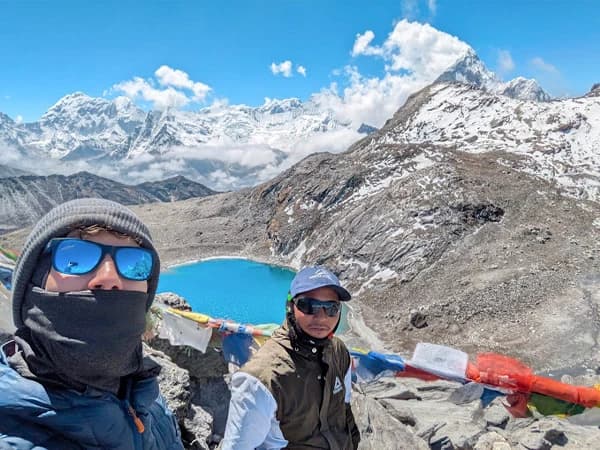
Trekkers who want to see more of the Khumbu can combine Base Camp with the Gokyo Valley on the Gokyo Chola Pass Trek with EBC (16 Days), crossing Cho La Pass at 5,420m (17,782ft).
Khumbu Glacier, world's highest glacier at 4,900m to 7,600m (16,076ft to 24,934ft). Base Camp sits on its right moraine at 5,364m (17,598ft).
Can you see Everest from Base Camp and what does it actually look like?
No. The Everest summit is not visible from Base Camp. The West Ridge and the Khumbu Icefall above block the sightline completely. This surprises most trekkers who have not read about it in advance.
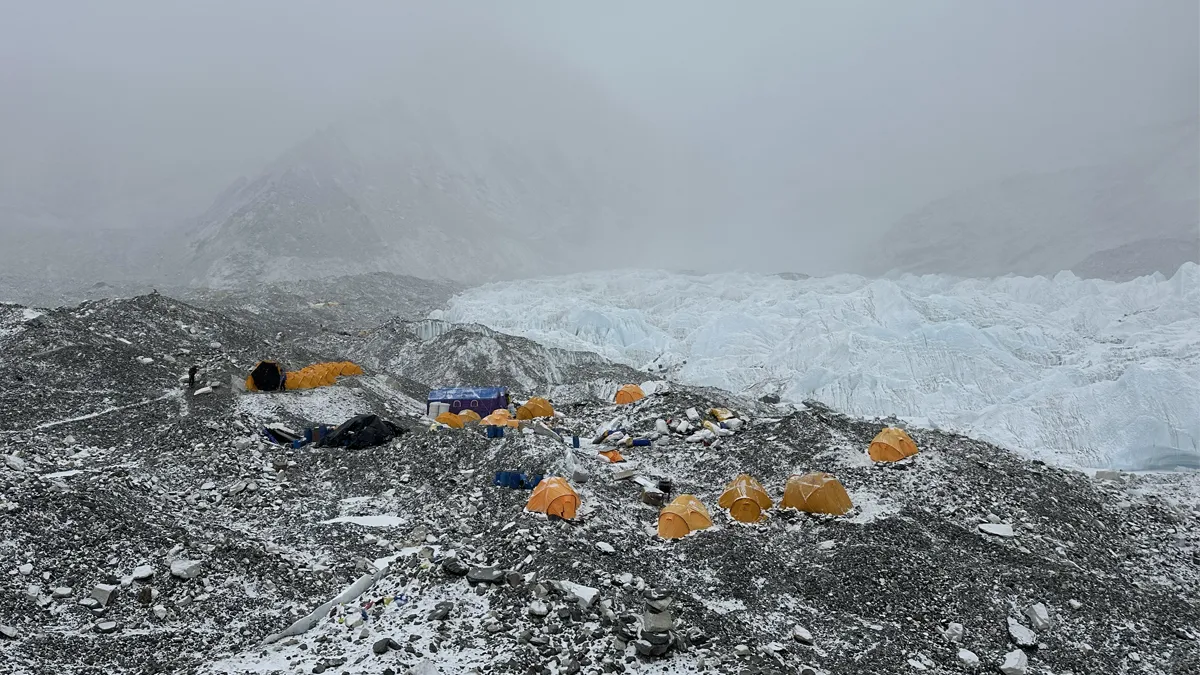
In spring (April to May), Base Camp is a functioning high-altitude community. More than 30 expedition teams may be camped simultaneously. Colour-coded tents, oxygen cylinders, fixed rope coils, and kitchen tents cover the moraine. The Khumbu Icefall directly above moves 0.9 to 1 metre per day, making audible cracking sounds as it shifts. Seracs the size of office buildings collapse without warning.
Outside the climbing season, Base Camp is quiet rock and glacier debris with a stone marker. The surrounding peaks, Nuptse (7,861m / 25,790ft) and the Lhotse face (8,516m / 27,940ft), create a scale that no photograph represents accurately.
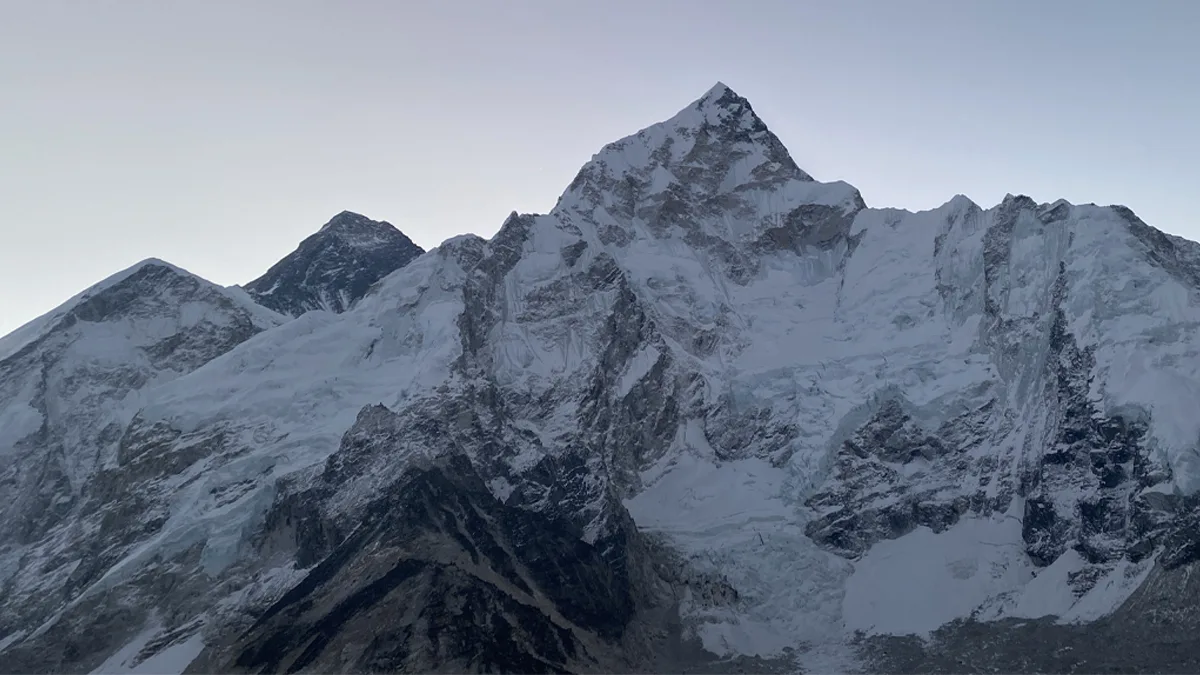
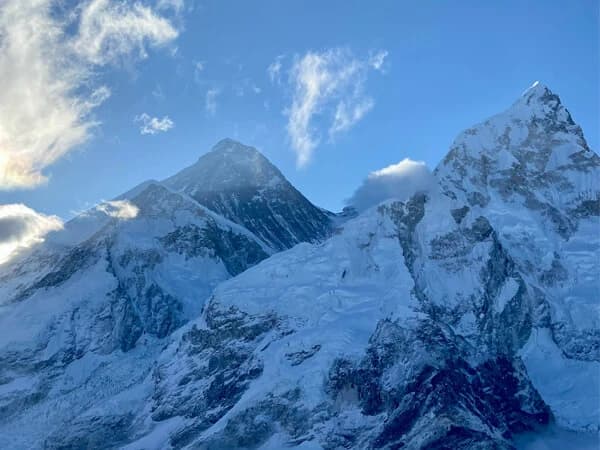
The Everest summit becomes visible from Kala Patthar at 5,545m (18,192ft), 3.5km (2.2mi) above Gorak Shep. We leave before dawn, reaching the top as first light catches the mountain. The summit turns orange before the rest of the range catches the light. Temperatures are between -15 and -20°C (5 to -4°F). Full down layers and headlamp are required. This is the moment most trekkers photograph. It is not something the photographs do justice to.
Everest summit from Kala Patthar (5,545m / 18,192ft) before dawn. Best visibility before 7am. Leave Gorak Shep by 4:30am.
Why 2 acclimatisation days and what happens if you skip them?
The body takes 24 to 48 hours to respond meaningfully to altitude by increasing red blood cell production. The 14-day itinerary builds in two mandatory rest days at Namche Bazaar (3,440m) and Dingboche (4,410m / 14,469ft).
Both days use the same protocol. Hike higher than your sleeping altitude during the day, return to sleep lower at night. Namche: hike to 3,880m (12,730ft), sleep at 3,440m (11,286ft). Dingboche: hike to 5,100m (16,732ft), sleep at 4,410m (14,469ft).
Skipping these days is the most common reason trekkers fail to reach Base Camp. We do not shorten either acclimatisation day on any Shikhar Adventure departure. One extra night in Namche costs far less than a helicopter evacuation from Lobuche.
Normal symptoms at altitude:
Mild headache on the first night at Namche or Dingboche
Reduced appetite
Disrupted sleep, vivid dreams
Slight breathlessness on stairs
Descend immediately if you experience:
Headache that worsens through the night despite rest and water
Loss of coordination or difficulty walking a straight line
Confusion or inability to complete simple tasks
Dry, persistent cough at rest
Chest tightness or gurgling breath at rest
The last two groups indicate HACE or HAPE. Both are medical emergencies. Descent is the only reliable treatment. Your guide makes the descent call, not the trekker. Helicopter evacuation from the Khumbu costs USD 3,000 to USD 6,000 and requires specialist insurance that explicitly covers rescue above 5,000m (16,404ft). Standard travel policies do not include this.
What permits are needed for the EBC trek in 2026?
Two permits are checked at the Sagarmatha National Park gate near Monjo, 90 minutes below Namche Bazaar. Both must be carried as originals throughout the trek. Rangers check at Monjo, Namche, and at higher checkpoints. Photocopies are not accepted.
Permit
Total Cost
Approx. USD
Where to get it
Sagarmatha National Park Entry Permit
NPR 3,000
~USD 20
Near Lukla or Monjo checkpoint
Khumbu Pasang Lhamu Rural Municipality Permit
NPR 3,000
~USD 20
Near Lukla or Monjo checkpoint
TIMS is no longer required in the Khumbu region as of 2026. Both permits are cash only in Nepali rupees. No USD or foreign currency accepted at any permit counter. Shikhar Adventure processes both permits before departure from Kathmandu. You receive originals on the morning of the Lukla flight.
What is the best season for the EBC trek and what are temperatures at each stage?
Spring and autumn are the two main windows. Both are suitable. The right choice depends on what you want to see at Base Camp and how much company you want on trail.
Season
Months
Day temp at EBC
Night temp at EBC
What to expect
Spring
March to May
-5 to +5°C / 23 to 41°F
-15 to -10°C / 5 to 14°F
Expedition season. Icefall active with climbing teams. Some afternoon haze.
Autumn
September to November
-8 to +2°C / 18 to 36°F
-18 to -12°C / -0.4 to 10°F
Clearest skies of the year. Sharpest views. Busiest trail.
Winter
December to February
-12 to -5°C / 10 to 23°F
-25 to -15°C / -13 to 5°F
Quiet trails. Some teahouses closed above Namche. Extremely cold.
Monsoon
June to August
+2 to +10°C / 36 to 50°F
-5 to 0°C / 23 to 32°F
Persistent cloud and rain. Trail erosion. Not recommended.
October is the most popular single month. For fewer people on trail, late March or early April delivers similar mountain views with significantly lower foot traffic. April is also when Everest expedition teams are most active at Base Camp.
Budget an additional USD 10 to 20 per day for personal trail expenses. Evacuation insurance covering helicopter rescue above 5,000m (16,404ft) costs USD 150 to 500 depending on your country and provider. Do not skip this.
Trekkers who want to save 2 to 3 days on the return can take the Everest Base Camp Helicopter Return (12 Days), flying back from Gorak Shep to Kathmandu instead of walking out to Lukla.
Can a beginner do the EBC trek and what fitness is required?
Yes. EBC requires no technical climbing, no prior high-altitude experience, and no specialist equipment beyond proper clothing and boots. Dambar Thapa has guided trekkers aged 15 to 74 to Base Camp.
What you need is the ability to walk 5 to 7 hours per day on uneven terrain for 10 to 12 consecutive days while carrying a 5 to 8kg (11 to 17.6 lb) daypack. The challenge is sustained effort at altitude, not any single difficult moment.
Three months of preparation is the minimum:
Uphill hiking or stair climbing, 3 to 4 sessions per week, 60 minutes minimum each
At least 2 multi-day hikes of 3 or more consecutive days before departure
Cardiovascular training: running, cycling, or swimming 3 times per week
Leg and core strength: squats, lunges, and step-ups with a loaded pack
The trekkers who fail are not the least fit. They are the ones who rush the acclimatisation days or do not tell their guide about worsening symptoms. Both are avoidable.
What do you need to pack for the EBC trek?
The goal is a daypack under 8kg (17.6 lb). Your porter carries the main duffel (maximum 15kg / 33 lb). Everything critical goes in your daypack, not the duffel.
Essential items in your daypack every day:
Down jacket, minimum 600-fill, rated to -15°C / 5°F
Waterproof shell jacket and trousers
Headlamp and spare batteries
Water: minimum 2 litres / 0.5 gallons capacity
Water purification tablets or UV pen
All medications including altitude medication if prescribed
Sunscreen SPF 50+ and glacier glasses with UV protection
Snacks: nuts, energy bars, chocolate
Trekking poles, highly recommended above Namche
Key items for the porter duffel:
Thermal base layers, 2 sets minimum
Insulated mid-layer, fleece or down sweater
Trekking trousers, 2 pairs
Warm hat, balaclava, liner gloves and outer mitts
Gaiters for snow sections above 4,500m (14,764ft) in winter or late autumn
Trekking boots, broken in before departure
Camp shoes or sandals for teahouses
Sleeping bag rated to -15°C / 5°F
Gear can be bought or rented in Kathmandu's Thamel district before the trek. Prices at Namche Bazaar run 20 to 30 percent higher than Thamel. Buy in Kathmandu, not on trail.
What accommodation and food is available on the EBC route?
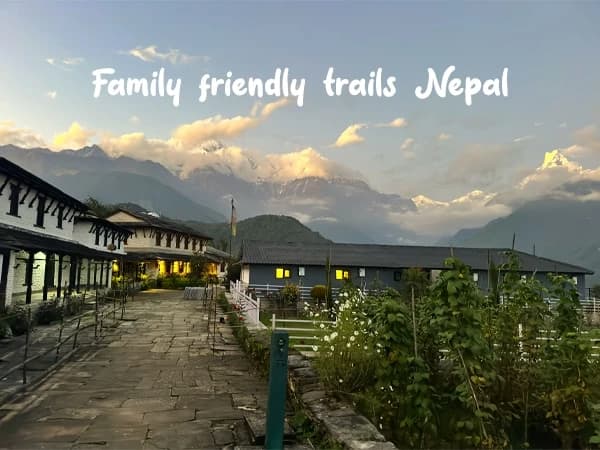
The entire route is served by teahouses: family-run lodges providing a room and meals. Standards drop with altitude. Below Namche, attached bathrooms and hot showers are available at mid-range lodges. Above 4,000m (13,123ft), facilities become more basic and prices increase for everything.
Stop
Altitude
Room (basic)
Hot shower
Wi-Fi
Phakding
2,610 m (8,563 feet)
~NPR 1000
Yes (NPR 300 to 500)
Yes
Namche Bazaar
3,440 m (11,286 feet)
~NPR 1000
Yes (NPR 300 to 500)
Yes
Tengboche
3,860 m (12,664 feet)
~NPR 1000
Limited (NPR 300 to 500)
Limited (paid)
Dingboche
4,410 m (14,469 feet)
~NPR 1000
Limited (NPR 300 to 500)
Limited (paid)
Lobuche
4,940 m (16,207 feet)
~NPR 1000
Unreliable
Satellite (paid)
Gorak Shep
5,164 m (16,942 feet)
~NPR 1000
Rarely available, Not Recommended
Satellite (paid)
Dal bhat (NPR 700 to 900, refillable) is the best food choice above Namche. It is freshly cooked, high in carbohydrates, and safest digestively. Avoid raw salads and unpeeled fruit above Namche. Drink 3 to 4 litres (0.8 to 1 gallon) daily. Carry a reusable bottle. Single-use plastic bottles are restricted inside Sagarmatha National Park.
Common questions about the Everest Base Camp trek
What altitude is Everest Base Camp?
Everest Base Camp (Nepal) is at 5,364m (17,598ft). The highest trekking point is Kala Patthar at 5,545m (18,192ft). The highest sleeping altitude is Gorak Shep at 5,164m (16,942ft), one night only.
How far is Everest Base Camp from Lukla?
65km (40 miles) one way from Lukla. Round trip is approximately 130km (80 miles). Most trekkers cover this in 12 to 14 days at 10 to 15km (6 to 9 miles) per walking day.
How difficult is the EBC trek?
Moderate to challenging. No technical climbing required. You need to walk 5 to 7 hours daily on uneven terrain for 10 to 12 consecutive days above 4,000m (13,123ft). Altitude is the challenge, not terrain steepness.
What is the best time to go to Everest Base Camp?
Autumn (September to November) for the clearest mountain views. Spring (March to May) for warmer temperatures and active expedition teams at Base Camp. October is the most popular single month. Late March gives similar views with far fewer trekkers.
What permits are needed for EBC in 2026?
Sagarmatha National Park Entry Permit: NPR 3,000 (approximately USD 20). Khumbu Pasang Lhamu Rural Municipality Permit: NPR 3,000 (approximately USD 20). TIMS not required in the Khumbu region as of 2026. Both permits must be originals.
Do you need a guide for EBC?
Yes, and not just because of the rules. Nepal's 2023 trekking regulations made a licensed guide mandatory in the Khumbu, enforced at permit checkpoints. But beyond compliance, a guide reads altitude symptoms before you do, adjusts your pace, decides when to descend, and coordinates evacuation if needed. At this altitude, the guide is the safety system, not a formality.
How much does the EBC trek cost in 2026?
Shikhar Adventure's EBC Trek (14 Days) costs USD 1,395 per person. Includes permits, all accommodation, all meals, licensed guide, porter, and Kathmandu transfers. Budget USD 150 to 400 additionally for specialist evacuation insurance.
Can you see Everest from Base Camp?
No. The West Ridge and Khumbu Icefall block the sightline from Base Camp. Kala Patthar at 5,545m (18,192ft), 3.5km (2.2mi) above Gorak Shep, is where the summit becomes visible at dawn in clear conditions.
Can a beginner do the EBC trek?
Yes. No technical skills required. Three months of fitness preparation, a 14-day itinerary with both acclimatisation days, and a licensed guide monitoring symptoms are what determine success. Dambar Thapa has guided trekkers aged 15 to 74 to Base Camp.
What happens if you get altitude sickness mid-trek?
Mild symptoms are normal at Namche and Dingboche. If symptoms worsen overnight, your guide descends you immediately. Helicopter evacuation costs USD 3,000 to USD 6,000 and requires specialist insurance. Your guide makes the evacuation call, not the trekker.
Is EBC better in spring or autumn?
Autumn (October especially) gives the clearest skies and sharpest mountain views. Spring is warmer and lets you see active Everest climbing expeditions at Base Camp. Both are good seasons. The choice is about what you want to see when you arrive.
What is Kala Patthar and why does everyone go there?
Kala Patthar at 5,545m (18,192ft) is the rocky viewpoint above Gorak Shep where the Everest summit is directly visible. Base Camp itself does not have a clear summit view. Most EBC itineraries include a pre-dawn Kala Patthar ascent on the morning after reaching Base Camp.
Practical advice from 300+ EBC expeditions
Do not skip either acclimatisation day. This single decision determines success or evacuation more than any other factor on the trek.
Tell your guide everything. A headache at Namche that worsens overnight is not normal. Your guide cannot make the right call without honest information from you.
Drink before you are thirsty. Above 4,000m (13,123ft), thirst response blunts. Three to 4 litres (0.8 to 1 gallon) per walking day, minimum.
Slow down above Lobuche. Two to three steps, then breathe. The pace that felt comfortable at Namche is too fast at 5,000m (16,404ft).
Book evacuation insurance before you arrive. Confirm explicitly that it covers helicopter rescue above 5,000m. Standard travel policies do not.
Buy gear in Kathmandu, not Namche. Namche prices run 20 to 30 percent higher and selection is limited to whatever is in stock that week.
Build two buffer days before your international departure. Lukla flights cancel due to weather. Do not book a connection home the day after your expected Kathmandu arrival from Lukla.
All medications in your daypack, not the duffel. The duffel goes on the porter. You need your medications with you on trail every walking day.
Everest Base Camp is not the destination most people imagine
You will spend 30 to 60 minutes at Base Camp after 14 days of walking. The camp is windy, rocky, and above 5,000m (16,404ft). There is no comfortable place to sit. The Everest summit is not visible. In spring, expedition tents and oxygen cylinders cover the moraine. Outside the climbing season, it is an open stretch of debris with a stone marker.
What most trekkers carry home is Kala Patthar before dawn. The headlamp convoy up the slope in the dark. The moment the Everest summit turns orange before anything else in the valley catches light. After 300 trips through this valley, that view still stops every group. No photograph of it is sufficient. You have to be standing there at 5,545m (18,192ft) in the cold to understand what it is.
The other thing worth saying: the Khumbu Valley itself is the experience. The suspension bridges over the Dudh Koshi, Tengboche Monastery at 3,860m (12,664ft), the yak caravans above Lobuche, the Thukla Pass memorial in the wind. Everest is the reason people come. The valley is why they remember it.
For trekkers who want the most complete Khumbu experience, the Three Passes Trek (18 Days) crosses Kongma La (5,535m / 18,159ft), Cho La (5,420m / 17,782ft), and Renjo La (5,340m / 17,520ft) in a full circuit that includes both Base Camp and the Gokyo Valley. It is the most complete way to experience everything the Everest region contains.
We have operated this route more than 300 times. The people who reach Kala Patthar are the ones who followed the schedule, drank the water, and told us when something felt wrong. The mountain gives you what you earn.