Tengboche sits on a high ridge at 3,867m (12,687ft) above the confluence of the Dudh Koshi and Imja Khola rivers. It is the largest monastery in the Khumbu region and a mandatory stop on the Everest Base Camp route. Every trekker heading to Base Camp passes through it. Most remember it longer than the destination itself.
What altitude is Tengboche Monastery and where is it on the EBC route?
Tengboche Monastery is at 3,867 m (12,687 feet). Coordinates: 27.8336°N, 86.6999°E. It sits on a forested ridge in the Solukhumbu District, within Sagarmatha National Park, between Namche Bazaar (3,440 m / 11,286 feet) and Dingboche (4,410m / 14,469ft) on the standard EBC route.
From Namche, the trail to Tengboche covers 11 km (6.8 miles) in 5 to 6 hours. It descends to Phunki Tenga (3,250 m / 10,663 feet) at the river crossing, then climbs steeply for approximately 600 m (1,969 feet) through rhododendron forest to the monastery ridge. The descent then the steep climb is the defining physical characteristic of the day.
Key fact
Detail
Altitude
3,867 m (12,687 feet)
Coordinates
27.8336°N, 86.6999°E
District
Solukhumbu, Koshi Province, Nepal
National Park
Sagarmatha National Park (UNESCO World Heritage Site)
From Namche Bazaar
11 km / 6.8 miles, 5 to 6 hours
From Tengboche to Dingboche
12 km / 7.5 miles, 5 to 6 hours
Entrance fee
NPR 300 per person
Resident monks
Approximately 60
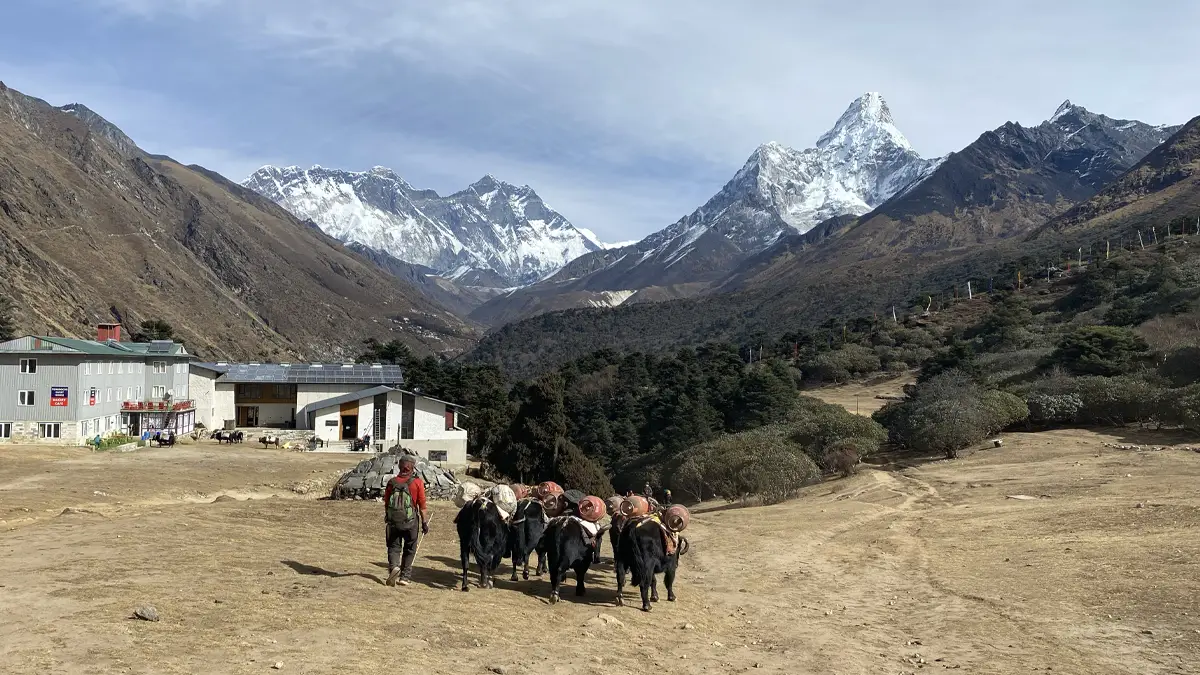
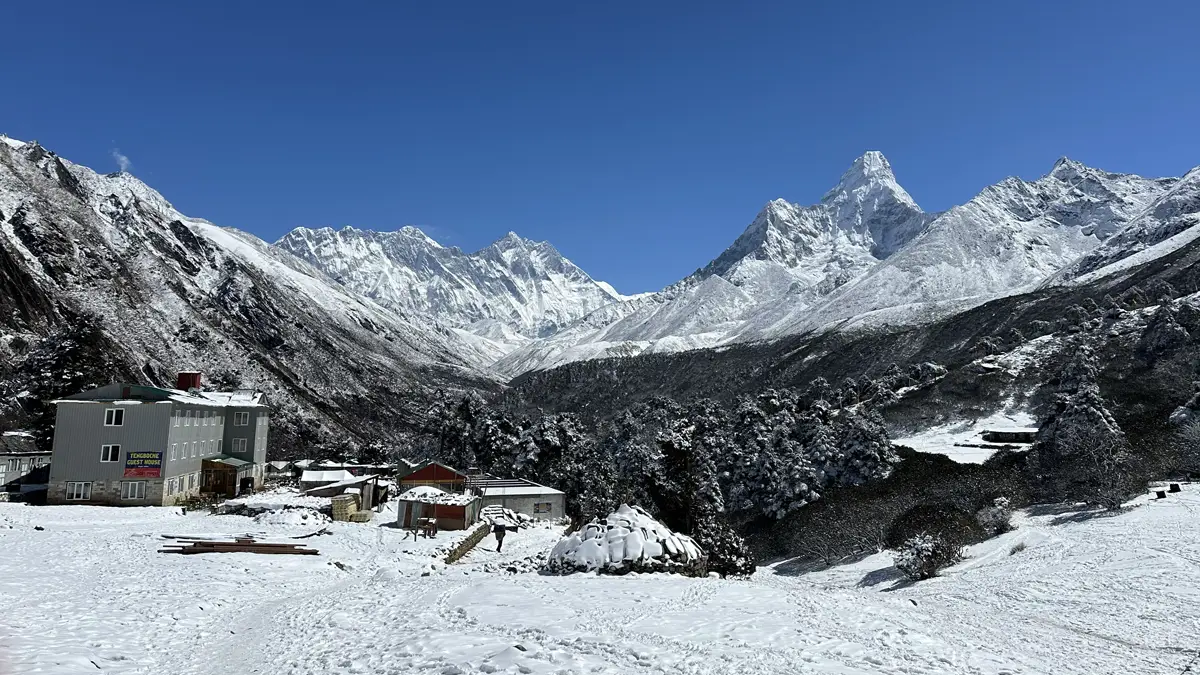
View from Tengboche ridge at 3,867m. Ama Dablam, Everest, Lhotse and Nuptse visible on a clear morning.
What is the founding history of Tengboche Monastery and who built it?
Tengboche Monastery was founded in 1916 by Lama Gulu, a monk blessed by Ngawang Tenzin Norbu, the abbot of Rongbuk Monastery on the northern face of Everest in Tibet. Rongbuk is the spiritual mother monastery of Tengboche. The site was funded by four wealthy Sherpa donors from Khumjung, Junbesi, Namche Bazaar, and Gole. Local Sherpa villagers contributed the labour. The main structure was completed in two months.
The spiritual connection to this ridge predates the monastery by centuries. Lama Sangwa Dorje, who founded the oldest monastery in the Khumbu at Pangboche approximately 350 years ago, is said to have prophesied that a major monastery would rise at Tengboche. A stone on the ridge carries what is believed to be his footprint from a meditation retreat. That stone cracked in the 1989 fire.
Tengboche follows the Nyingma tradition, the oldest of the four main schools of Tibetan Buddhism, in the Vajrayana lineage. It is the oldest celibate monastery in the Khumbu region.
What destroyed Tengboche Monastery twice and how was it rebuilt?
The monastery has been destroyed twice and rebuilt twice. Both events are part of what defines it.
The first destruction came in 1934, when a major earthquake levelled the main temple. Lama Gulu died during or shortly after the earthquake. The Sherpa community and a skilled carpenter brought from Lhasa rebuilt the structure using community donations.
The second destruction was more specific. On January 19, 1989, an electrical short circuit in the newly installed power system started a fire that consumed the main prayer hall entirely. Irreplaceable manuscripts, statues, murals, and hand-carved woodwork accumulated since 1916 were lost. The stone credited with Lama Sangwa Dorje's footprint fractured in the heat.
The rebuilding after 1989 drew international attention and funding. Edmund Hillary's Himalayan Trust was among the contributors. The reconstruction produced a larger, more structurally resilient main hall than the one it replaced, though it could not recover what the fire destroyed. The monastery that stands today is the product of that rebuilding.
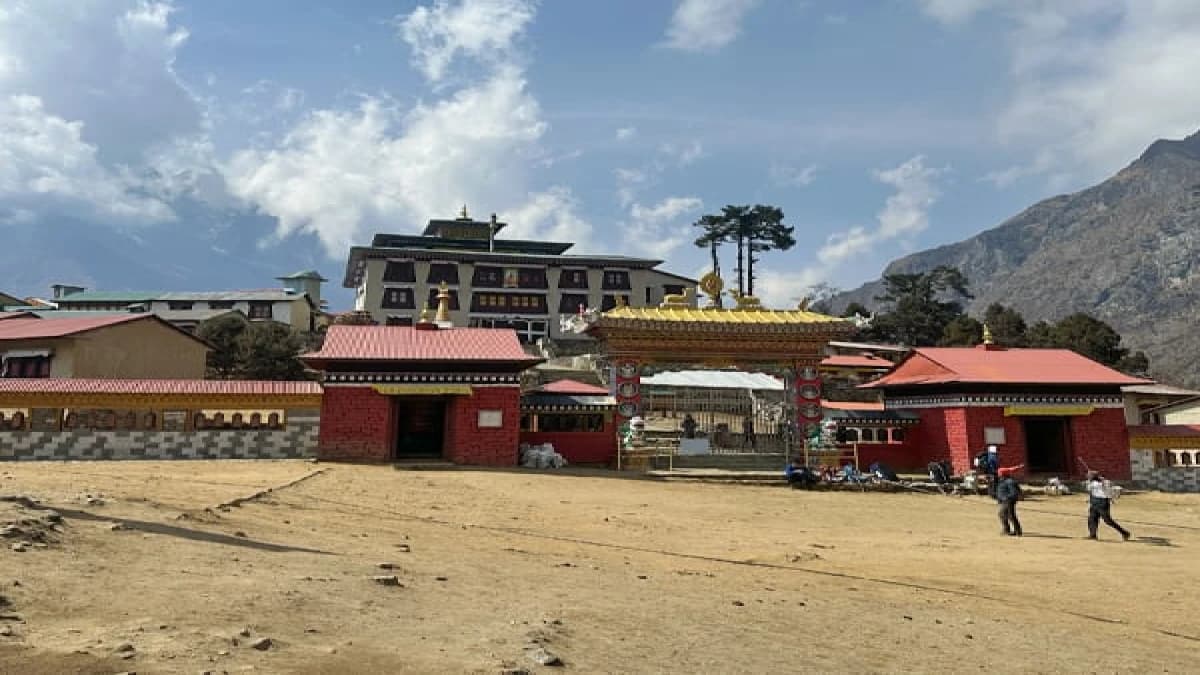
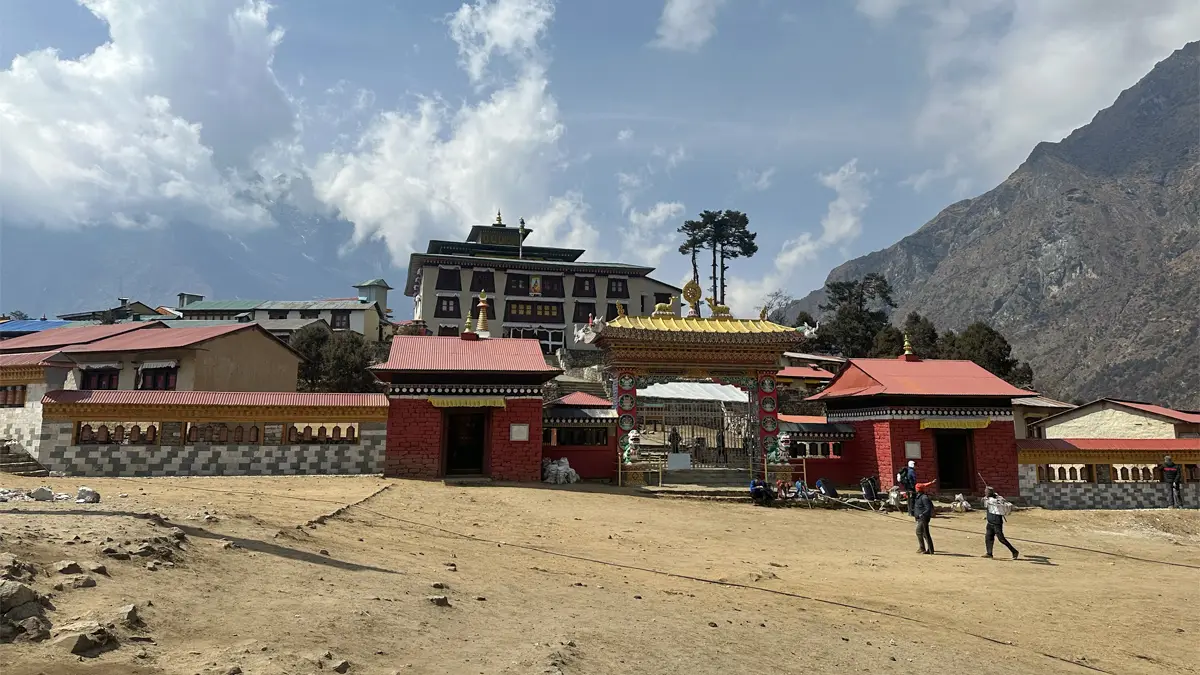
The monastery courtyard. Walk clockwise around the stupa. Entrance fee NPR 300 at the gate.
What do you see and experience when you arrive at Tengboche?
The approach matters as much as the arrival. The climb from Phunki Tenga (3,250 m / 10,663 feet) through the rhododendron forest is steep and sustained. Most trekkers arrive breathing harder than expected. Then the trail levels, the forest opens, and the ridge appears. The monastery is directly ahead. Ama Dablam (6,812 m / 22,349feet) sits behind it.
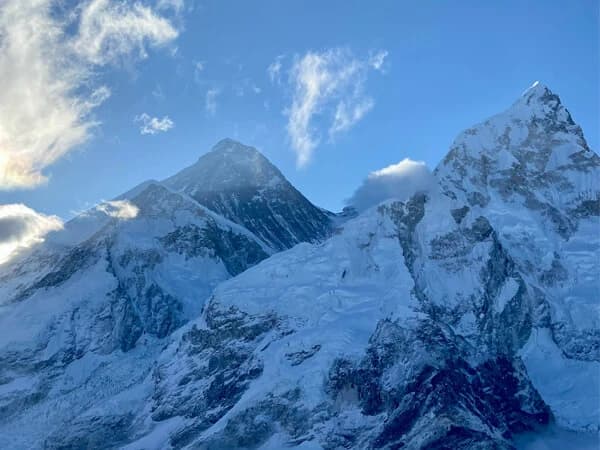
That view stops most groups. After two days of forested valley walking, the sudden scale of the high peaks is the first indication of what is above Tengboche. Everest (8,848.86 m / 29,031.7 feet), Lhotse (8,516 m / 27,940 feet), Nuptse (7,861 m / 25,790 feet), and Thamserku (6,623 m / 21,729 feet) are all visible from the monastery courtyard on a clear morning. Ama Dablam dominates the immediate view.
The entrance fee is NPR 300 per person, collected at the gate. It covers access to the monastery grounds and the main prayer hall, the Dukhang. Inside the Dukhang, large statues of Guru Rinpoche and other central deities stand against vibrant thangkas and hand-painted murals depicting Buddhist teachings. Morning puja ceremonies begin as early as 4am. If you arrive the evening before and are staying overnight, attending the dawn chants is worth the early start. The sound carries across the ridge in the cold and is unlike anything you hear elsewhere on the route.
Visiting protocol is straightforward. Remove boots before entering the prayer hall. Walk clockwise around the stupa in the courtyard. Ask before photographing monks or the interior. Keep voice low inside the complex. Monks are conducting active religious practice, not performing for trekkers.
What is the Mani Rimdu festival at Tengboche and when does it happen?
Mani Rimdu is the most significant annual event at Tengboche and the most important festival of the Sherpa people. It falls on the tenth lunar month of the Tibetan calendar, which corresponds to October or November in the Gregorian calendar. In 2026, Mani Rimdu at Tengboche falls in October and it'll be open for public celebration on 26th, 27th and 28th.
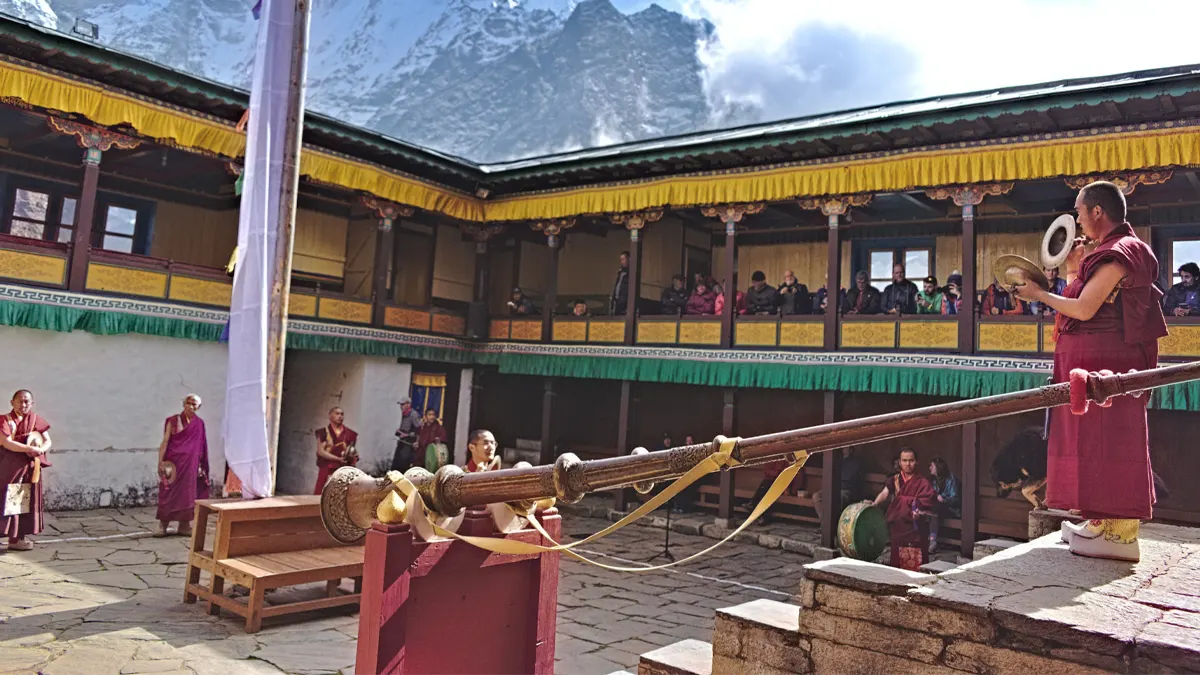
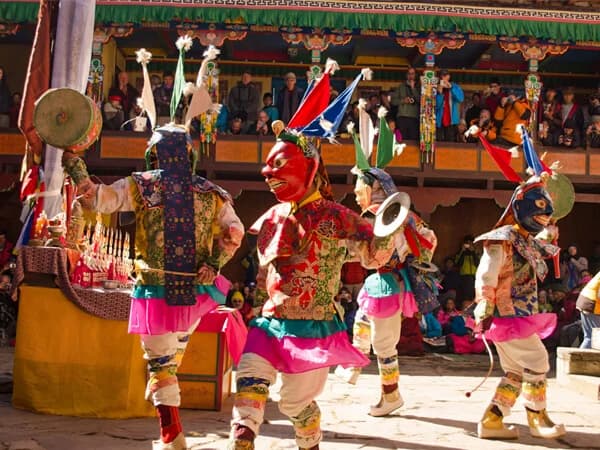
The festival is frequently described as a three-day event. This requires clarification. The ceremonial preparation and ritual cycle lasts 19 days in total. The public-facing portion, including the masked dances (Cham) performed by monks in the monastery courtyard, runs for three days. The Cham dances depict the victory of Buddhism over the Bon tradition and the lives of important figures in the Nyingma lineage. The final day involves a fire ritual.
Trekkers who time their EBC trip to coincide with Mani Rimdu find the monastery at its fullest. Monks from surrounding gompas arrive. Sherpa families from villages across the Khumbu attend. The courtyard fills with colour. If you are planning an autumn EBC trek and Mani Rimdu dates align with your Tengboche stop, the experience adds a dimension to the route that has nothing to do with altitude or distance.
Rongbuk Monastery in Tibet shares the same Mani Rimdu tradition. Both trace the festival to the same Nyingma lineage through which Tengboche was founded.
Mani Rimdu at Tengboche. The 3-day public masked dance falls in October. Full ceremony lasts 19 days.
What is the mountain view from Tengboche and when is it best?
The view from Tengboche ridge is arguably the most complete single panorama on the EBC route. It is the first point on the standard itinerary where Everest, Lhotse, Nuptse, Ama Dablam, Thamserku, Kangtega, and Taboche are all visible simultaneously from an open, level vantage point.
Morning gives the best clarity. Cloud typically builds from the valley by mid-morning and often surrounds the ridge by early afternoon. If you arrive at Tengboche the evening before your scheduled departure toward Dingboche, the early morning light on Ama Dablam and the Everest group is the most photographed view on the entire route. We plan Tengboche stops to catch that morning window before continuing higher.
In spring (March to May), the rhododendron forest below the ridge blooms red and pink on the approach. The combination of flowering forest in the foreground and snow-covered peaks behind Tengboche is specific to this season. Autumn delivers sharper views with less haze. Both are worth seeing for different reasons.
Accommodation and facilities at Tengboche
Tengboche has several teahouses immediately adjacent to the monastery and in the surrounding area. Facilities are basic. Rooms are simple double or dormitory with shared bathrooms. Hot showers are limited and solar-dependent. Wi-Fi is available but unreliable. Device charging costs NPR 150 to 200 per item.
Some trekkers continue 30 minutes further down to Debuche (3,820 m / 12,533 feet), which has slightly more accommodation options and is marginally lower for sleeping. The altitude difference is minimal. If you want to wake up at Tengboche for the morning mountain view, stay at Tengboche. If the lodges are full during peak season, Debuche is the practical alternative.
Food at Tengboche follows the standard teahouse menu: dal bhat, noodles, soup, eggs, bread, and tea. Dal bhat (NPR 700 to 900) remains the recommended choice above 3,500m (11,483ft). Prices are higher than Namche because all supplies are carried by porter or yak from the valley below.
Common questions about Tengboche Monastery
What altitude is Tengboche Monastery?
Tengboche Monastery is at 3,867m (12,687ft) above sea level, in the Solukhumbu District, within Sagarmatha National Park. It sits between Namche Bazaar (3,440 m / 11,286 feet) and Dingboche (4,410 m / 14,469 feet) on the standard EBC route.
Who founded Tengboche Monastery and when?
Tengboche was founded in 1916 by Lama Gulu, blessed by Ngawang Tenzin Norbu, abbot of Rongbuk Monastery in Tibet. The site was funded by four Sherpa donors and built by community labour in approximately two months. It is the largest monastery in the Khumbu and the oldest celibate gompa in the region.
What happened to Tengboche Monastery in 1989?
On January 19, 1989, an electrical short circuit in the newly installed power system started a fire that destroyed the main prayer hall. Irreplaceable manuscripts, statues, murals, and wood carvings accumulated since 1916 were lost. The stone carrying Lama Sangwa Dorje's footprint fractured in the heat. The monastery was rebuilt with international assistance including contributions from Edmund Hillary's Himalayan Trust.
When is the Mani Rimdu festival at Tengboche?
Mani Rimdu falls on the tenth lunar month of the Tibetan calendar, corresponding to October or November. The full ceremonial cycle lasts 19 days. The public masked dances (Cham) performed by monks in the courtyard run for three days. In 2026, Mani Rimdu at Tengboche falls in November.
Can you see Everest from Tengboche?
Yes. Everest is visible from the Tengboche ridge on a clear morning, along with Lhotse, Nuptse, Ama Dablam, Thamserku, and Kangtega. It is the first point on the standard EBC route where the full Khumbu peak panorama is visible simultaneously. Morning before 9am gives the clearest views.
What is the entrance fee at Tengboche Monastery?
The entrance fee is NPR 300 per person. This covers access to the monastery grounds and the main prayer hall. Shikhar Adventure includes this fee within the EBC trek package.
Should you stay overnight at Tengboche or continue to Debuche?
Stay at Tengboche if you want the morning mountain view from the ridge before continuing to Dingboche. The view at dawn, with the first light on Ama Dablam and the Everest group, is the best reason to overnight here. If Tengboche lodges are full during peak season, Debuche is 30 minutes below and a viable alternative at a marginally lower altitude.
What is the correct visiting protocol at Tengboche?
Remove boots before entering the prayer hall. Walk clockwise around the stupa. Keep voice low inside the complex. Ask permission before photographing monks or interior spaces. The monastery is an active place of religious practice. The NPR 300 entrance fee is paid at the gate on arrival.
Tengboche after snowfall. Winter visits are possible but some teahouses close and temperatures drop sharply overnight.
What Tengboche means on the EBC route
Tengboche is the point where the EBC trek changes character. Below it, the trail is forested valley walking with the high peaks appearing occasionally above the treeline. Above it, the Khumbu opens into the glacier world. The monastery sits exactly at that transition.
Most groups spend an hour to two hours at Tengboche before continuing. Those who overnight get the dawn puja and the morning view. Both are worth planning for. A monastery that has been destroyed twice and rebuilt by the same community that continues to inhabit the valley around it is not background scenery. It is the reason the Khumbu looks the way it does. The Sherpa villages, the prayer flags, the mani walls along the trail, the memorial cairns at Thukla Pass above, all connect to the same tradition that has maintained Tengboche since 1916.
We have passed through Tengboche more than 30 times. It looks different depending on the season, the light, and whether the clouds have cleared. The view behind the monastery changes every morning. The monastery itself does not.
Updated June 2026 by the Shikhar Adventure team, with input from Dambar Thapa.